Home › Volumes › Moths › Tineidae Family
Yucca Moth
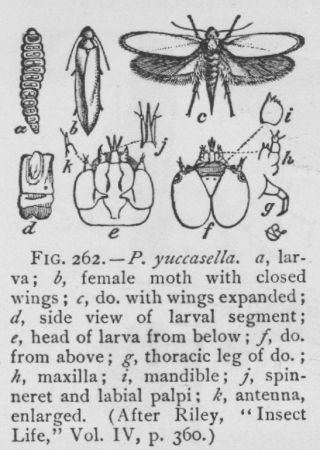
No discovery in recent years has been more interesting to students of insect and plant life than that which was made in 1872 by Professor Riley, of the intimate relationship which subsists between the beautiful plants, known as Yuccas, and the genus of moths to which the present species belongs. It has been ascertained that the fructification of the various species of Yucca is almost absolutely dependent upon the agency of the female moth; and, strangely enough, it has also been ascertained that the pollenation of the flowers is not the result of mere accidental attrition of the wings and other organs of the insect when engaged in seeking for nectar in the flower and when engaged in laying her eggs, but that she deliberately collects the pollen with her mouth, which is peculiarly modified to enable her to do this, and then applies the pollen to the stigma with infinitely better care than it could be done by the most skilful horticulturist using the most delicate human appliances.
There are several species of the genus Pronuba, and they hold a positive and well-ascertained relationship to the various species of the plants in the economy of which they perform so important a function. Pronuba yuccasella pollenizes in the Eastern States the blossoms of the common Yucca filamentosa, and on the Western plains it performs the act for the blossoms of Yucca angustifolia. Yucca brevifolia is pollenized by Pronuba synthetica. Yucca whipplei is pollenized by Pronuba maculata. No doubt there are other species of Yucca which will be ultimately discovered to have species of Pronuba which are adapted in their organs to the work of pollenation according to their peculiar requirements.
The larva of Pronuba, after it has attained to full size, drops to the ground, having three pairs of thoracic legs, which enable it to move about and burrow into the earth. It then undergoes transformation into the pupal state. The chrysalis, which is depicted in Fig. 263, has the back armed with peculiar spinous processes, which enable it to make its way through the loose soil.
The student who desires to become fully acquainted with this interesting chapter in insect life must consult the altogether admirable papers written upon the subject by Professor Riley, to whom we are indebted for almost all that we know in regard to the subject. These papers may be found in the Publications of the St. Louis Academy of Science, the "Fifth Annual Report of the State Entomologist of Missouri," and in the fourth and fifth volumes of "Insect Life."