Home › Volumes › Moths › Tussock Moths
White-marked Tussock Moth
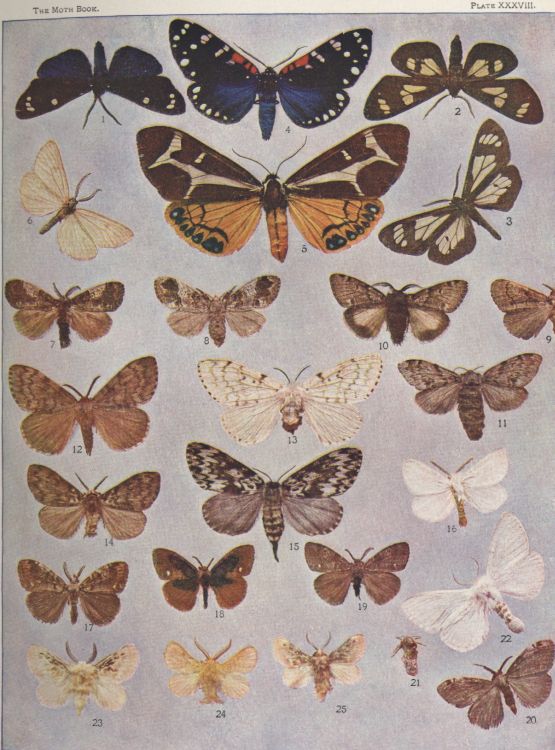
The moth is widely distributed in the Appalachian subregion, and its ravages upon shade-trees and shrubbery are matter of familiar observation. The insect is double-brooded in the more northern portions of its range, and triple-brooded farther south. The first generation is matured from eggs which, having been deposited in the fall of the year, remain in situ upon the cocoons upon which they were deposited until they are hatched by the heat of the sunshine of spring. The caterpillars rapidly develop, and the second generation, which is always much more numerous than the first, begins to appear about the middle of July in the latitude of New York and Philadelphia.
A third generation follows in the month of September. This generation lays the eggs from which the larvae which appear in the following spring are hatched.
The female, as has already been stated, is wingless, and lives solely for the purpose of oviposition. Having laid her eggs, which she covers with the hairy scales which she plucks from the abdomen, and mingles with a viscid secretion, which she deposits with the eggs, and which on drying becomes hard and brittle, she dies. The young larva on being hatched has the power of spinning a thin thread of silk, with which it lowers itself from its resting-place when disturbed, and by means of which it regains the place from which it has dropped. This power is lost as the insect develops after successive molts. The mature caterpillar is a rather striking and not unbeautiful creature. The head is brilliant vermilion in color; the body is white banded with black, and adorned with black-tipped tufts and bundles of cream-colored hairs. There is considerable disparity in the size of the larvae and the pupae of the two sexes, as is partially shown in Fig. 183. The larva and the pupa of the female moth are generally twice as large as those of the male.
The best means of combating the ravages of this insect is to see to it that in the fall and winter the cocoons, which may be found adhering to the twigs of trees and shrubs and secreted in the nooks and crannies of fences, are gathered together and destroyed. It is also useful to spray the young foliage of trees which are liable to attack with any one of the preparations which are made by reputable firms for the purpose of destroying the larvae of this and other destructive insects which attack our shade-trees. The spraying should take place at intervals when the young larvae are observed to be moving upward upon the trunks of the trees.