Home › Volumes › Moths › Geometer Moths
Walnut Spanworm
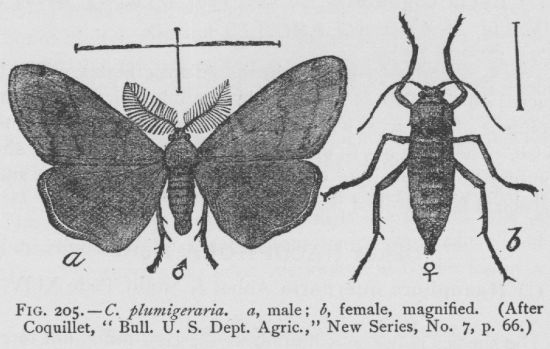
In recent years the groves of English walnuts in southern California have been found to be liable to the attack of a span-worm, which previously had been unknown or unobserved. The trees had up to that time been regarded as singularly immune from the depredations of insect pests, and considerable alarm and apprehension were felt when it was found that a small caterpillar had begun to ravage them. The insect feeds also upon the leaves of various rosaceous plants, and upon the oak. The taste for the foliage of the English walnut has evidently been recently acquired.
An excellent article upon these insects was published in 1897 by D.W. Coquillet in the "Bulletins of the United States Department of Agriculture," New Series, No. 7, p. 64. From this article we have taken the accompanying cuts, and from it we draw some of the facts herein set forth. In describing the insect Mr. Coquillet says: "The color of the caterpillar is a light pinkish gray, varied with a darker gray or purplish, or sometimes with black and yellow, but never marked with distinct lines; the piliferous spots are black or dark brown, and the spiracles are orange yellow, ringed with black, and usually situated on a yellow spot. The worms become full grown in the latter part of April or during the month of May; they then enter the earth to a depth of from two to four inches and form small cells, but do not spin cocoons. The change to the chrysalis takes place shortly after the cells are completed, and the chrysalis remains unchanged throughout the entire summer and until early in the following year, when they are changed into moths, which emerge from the ground from the first week in January to the last week in March. The male moth is winged, but the female is wingless and is so very different in appearance from the male that no one not familiar with the facts in the case would ever suspect both belong to the same species."
The best means of combating these pests has been found to be to spray the trees, when the caterpillars are just hatching, with a solution of Paris green and water, one pound of the poison to two hundred gallons of water.