Home › Volumes › Moths › Foresters
Two-spotted Forester
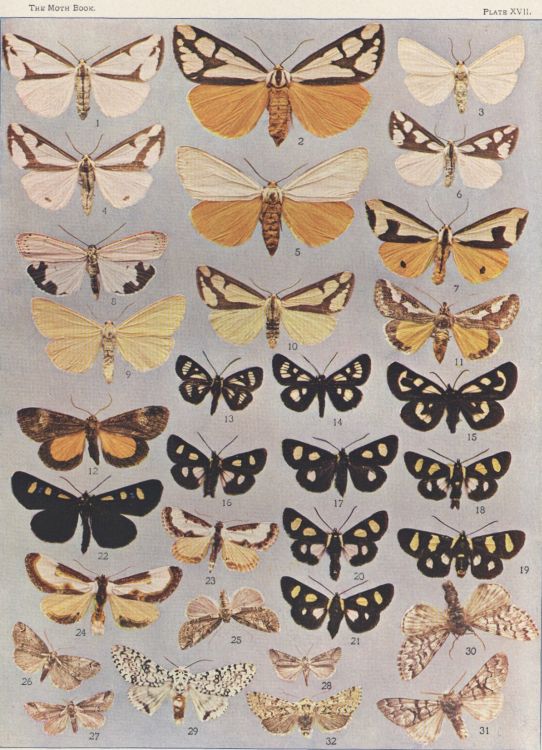
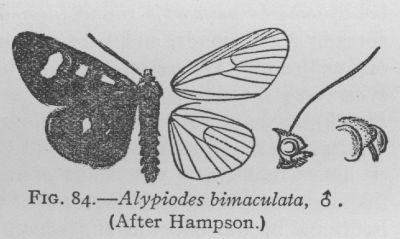
The figure in the plate represents the typical form, the figure in the cut shows the aberration named crescens by Walker, in which the hind wing has a yellow spot about the middle of the wing. The insect is fairly common in southern California, New Mexico, and Arizona.
"The entomologist need not relax his endeavors day or night. Mothing is night employment."-A.S.PACKARD.
SUGARING FOR MOTHS
The day has been hot and sultry. The sun has set behind great banks of clouds which are pilling up on the northwestern horizon. Now that the light is beginning to fade, the great masses of cumulus, which are slowly gathering and rising higher toward the zenith, are lit up by pale flashes of sheet-lightning. As yet the storm is too far off to permit us to hear the boom of the thunder, but about ten or eleven o'clock to-night we shall probably experience all the splendor of a dashing thunder shower.
Along the fringe of woodland which skirts the back pastures is a path which we long have known. Here stand long ranks of ancient beeches; sugar maples, which in fall are glorious in robes of yellow and scarlet; ash trees, the tall gray trunks of which carry skyward huge masses of light pinnated foliage; walnuts and butternuts, oaks, and tulip-poplars. On either side of the path in luxuriant profusion are saplings, sprung from the monarchs of the forest, young elm trees planted by the winds, broad-leaved papaws, round-topped hawthorns, viburnums, spreading dogwoods, and here and there in moist places clumps of willows. Where the path runs down by the creek, sycamores spread their gaunt white branches toward the sky, and drink moisture from the shallow reaches of the stream, in which duckweed, arrow-weed, and sweet pond-lilies bloom.
The woodland is the haunt of many a joyous thing, which frequents the glades and hovers over the flowers. To-night the lightning in the air, the suggestion of a coming storm which lurks in the atmosphere, will send a thrill through all the swarms, which have been hidden through the day on moss-grown trunks, or among the leaves, and they will rise, as the dusk gathers, in troops about the pathway. It is just the night upon which to take a collecting trip, resorting to the well-known method or "sugaring."
Here we have a bucket and a clean whitewash brush. We have put into the bucket four pounds of cheap sugar. Now we will pour in a bottle of stale beer and a little rum. We have stirred the mixture well. In our pockets are our cyanide jars. Here are the dark lanterns. Before the darkness falls, while yet there is light enough to see our way along the path, we will pass from tree to tree and apply the brush charged with the sweet semi-intoxicating mixture to the trunks of the trees.
The task is accomplished! Forty trees and ten stumps have been baptized with sugar-sweetened beer. Let us wash our sticky fingers in the brook and dry them with our handkerchiefs. Let us sit down on the grass beneath this tree and puff a good Havana. It is growing darker. The bats are circling overhead. A screech-owl is uttering a plaintive lament, perhaps mourning the absence of the moon, which to-night will not appear. The frogs are croaking in the pond. The fireflies soar upward and flash in sparkling multitudes where the grass grows rank near the water.
Now let us light our lamps and put a drop or two of chloroform into our cyanide jars, just enough to slightly dampen the paper which holds the lumps of cyanide in place. We will retrace our steps along the path and visit each moistened spot upon the tree-trunks.
Here is the last tree which we sugared. There in the light of the lantern we see the shining drops of our mixture clinging to the mosses and slowly trickling downward toward the ground. Turn the light of the lantern full upon the spot, advancing cautiously, so as not to break the dry twigs under foot or rustle the leaves. Ha! Thus far nothing but the black ants which tenant the hollows of the gnarled old tree appear to have recognized the offering which we have made. But they are regaling themselves in swarms about the spot. Look at them! Scores of them, hundreds of them are congregating about the place, and seem to be drinking with as much enjoyment as a company of Germans on a picnic in the wilds of Hoboken.