Home › Volumes › Moths › Psychidae Family
Thyridopteryx Ephemeraeformis
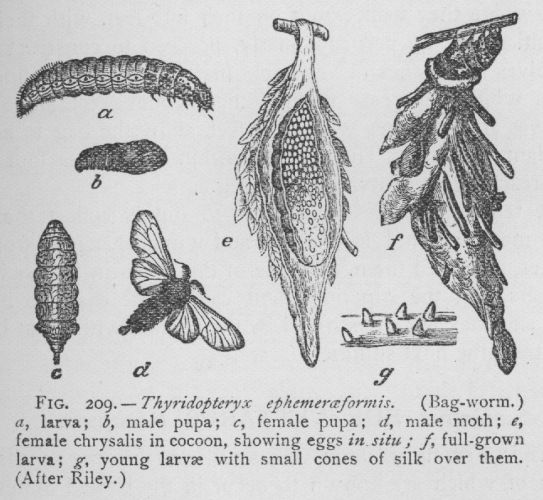
The common "Bag-worm," as it is usually called, occurs throughout the Appalachian subregion, from the Atlantic to the borders of the Great Plains. It is a very promiscuous feeder, attacking trees and shrubs of many genera, but, so far as is known, abstaining from the Gramineae. It evinces special fondness for the conifers, and above all for the red cedar and arborvitae. It has proved very injurious to shade-trees in some of our cities, and its ravages in St. Louis and Washington have been made the subject of repeated comment in the literature of economic entomology. A very full and interesting account of the habits of this peculiar insect was published by the late Professor C. V. Riley in the "First Annual Report of the State Entomologist of Missouri," to which the reader will do well to refer. The "bag," or "basket," of the male insect is smaller than that of the female. The males escape from the lower end of the case in the winged form, and having copulated with the females, which remain in their cases and are apterous and sluggish, die. The female deposits her eggs, which are soft and yellow, in the sack where she has her home, and ends her existence by leaving what little of her body remains after the ova have been extruded, as a sort of loose plug of desiccated tissue at the lower end of the sack. The eggs remain in the case till the following spring, when they hatch. The young larvae emerge, and placing themselves upon the leaves, where they walk about on their fore feet, with their anal extremities held up perpendicularly, proceed to construct about themselves little cones of vegetable matter mixed with fine silk. After a while they cease to hold these cones erect, and seizing the leaves and branches with their feet, allow the bag to assume a pendant position. They moult within their cases four times before reaching maturity and pupating.
The remedy for these insects is to simply collect the cases which may be found in the fall and winter hanging from the branches, and burn them. In one of the parks in St. Louis several years ago, the superintendent caused the cases to be collected, and they were destroyed by the bushel, with great benefit to the trees the next summer.