Home › Volumes › Moths › Pyralidae Family
Rascal Leaf-crumpler
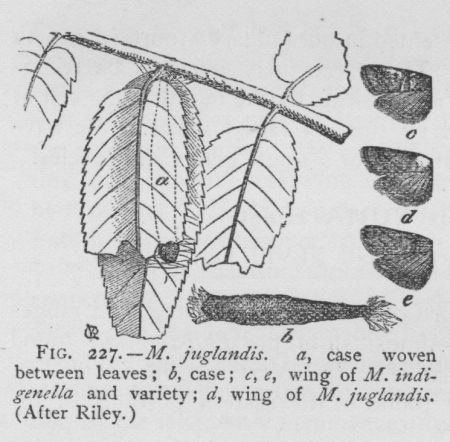
This moth is common in the Valley of the Mississippi and in Ontario, but does not appear to be very common in the Eastern States, and is unknown in the extreme southern portions of our region. It is very common in western Pennsylvania.
Professor C. V. Riley describes its habits as follows: "It is one of those insects which is hardly noticed while it is carrying on its most destructive work; for it is most voracious during the leafy months of May and June, and is then more or less hidden by the foliage of the tree, which it so effectually helps to denude. But the nakedness of winter, though it does not reveal the surreptitious worm, lays bare and renders conspicuous its little house, and these houses-these larval cases-whether closely attached in clusters to the twigs as in Figure 228, b, or hidden in a few seared and silk-sewn leaves as at Figure 229, are unerring tokens of past injury to the tree, and symbols of increased injury in the future, unless removed. The bunches of leaves anchored to the tree by strong silken cables and breasting defiantly every winter's wind are, indeed, significant insignia upon which is written in characters, if not in words-'result of careless culture and unpardonable neglect.'
There is but one brood a year, and the larva, about one-third grown, invariably passes the winter protected in its case. At this season of the year it is always of a deep reddish-brown color. As the leaves expand in spring it rouses from its winter lethargy, and after 'heaving anchor'-to use a nautical expression-by severing the silken connections of its case, travels in search of food, and having found it, secures its case again, and breaks its long fast. Toward the end of May it acquires its growth, when the earlier brown color frequently takes on a more or less decided deep green hue. It is a smooth worm with the head and thoracic joints as represented at c. The case at this time usually presents the appearance of Figure 228, a, being crooked and twisted like a little horn, gradually enlarging, cornucopia-fashion, from tip to mouth, and reminding one strongly of a piece of bird-dung. It is formed of the worm's excrement and other debris, interwoven with silk, and is completely lined on the inside with a carpet of the last-named material. The worm leaves it for feeding purposes mostly during the night. The chrysalis is formed inside this case, and the moths commence to make their appearance during the fore part of June, and later as we go farther north."
The insect feeds principally upon the Rosaceae, and is very injurious to orchards, attacking apple-trees, plums, quinces, cherries, and certain varieties of pears, especially the Seckel pear.