Home › Volumes › Moths › Giant Silkworm Moths
Polyphemus Moth
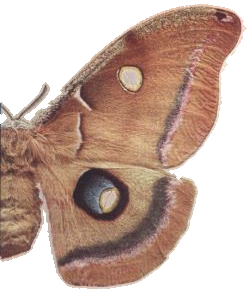
This very common moth feeds in the larval stage upon a great variety of trees and shrubs. I have found the caterpillar upon various species of oaks, upon the two species of Juglans, which grow in the Eastern States, upon hickory, basswood, elms, maples, birches, chestnuts, the sycamore (Platanus), wild roses, and the beech. Other observers have reported the larva as found upon a great variety of other trees. The caterpillar, which is of a beautiful shade of green, is ornamented on the sides by raised lines of silvery white, and is altogether a beautiful object, so far as coloration is concerned. The cocoon is in form like that of Actias luna, but is much more dense, and, after it has been spun up, is injected by the larva with a fluid, which appears to precipitate a white chalky matter through the fibers after it has dried. Efforts to reel the silk have hitherto amounted to but little. The insect is double-brooded in the southern States.
In Pennsylvania and northward it is single-brooded. The moth ranges across the entire continent and into Mexico in the South. We have given in Figure 5 a representation of the pupa, in Figure 10 a cut of the antenna greatly enlarged, and in Figures 41 and 42 are shown the larva and the cocoon. The latter, as is illustrated in the cut, is spun among leaves, and falls in the autumn to the ground. A number of aberrant forms and local races have been described, and there is considerable variety in the depth of the ground-color of the wings in a long series of specimens collected in the same locality. I have one or two fine melanic specimens, in which the wings are almost wholly black on the upper side. Albino specimens are also occasionally found.