Home › Volumes › Moths › Aegeriidae Family
Paranthrene Heucherae
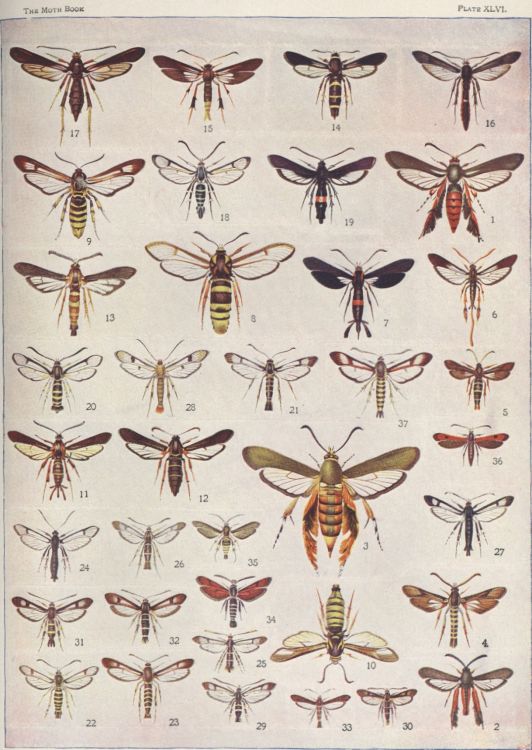
There are several species in the genus found in the United States, which are all, as yet, rare in collections, and little is known as to their life-history. The present species has been found in New Mexico.
FAUNAL SUBREGIONS
This volume is an attempt to bring together into compact form an account of the commoner and more striking species of moths which are found in the United States and Canada. The area is vast, and zoologists as well as botanists have for the purposes of science subdivided the region into what are known as "faunal subregions," or "botanical subregions." These subdivisions of the territory are entirely natural and are based upon a knowledge of the flora and fauna of each area. Both flora and fauna are more or less dependent upon conditions of soil, rainfall, and temperature.
Beginning with the Atlantic coast, we find a large area extending from Nova Scotia, Quebec, and Ontario, southward through New England, the Middle States, and the Eastern Central States as far south as the Carolinas and northern Georgia, Alabama, and Mississippi, westward into Arkansas, Missouri, and eastern Kansas, then northward through eastern Iowa and Minnesota, in which, with some slight variations, the predominant features of the vegetation and of the fauna are alike. In a broad way this territory is known as the Appalachian subregion. It has been subdivided into two parts, to the more northern of which has been applied the name Canadian, and to the southern the name Carolinian. These minor subdivisions of the broader subregion are quite natural, and are based upon the fact that certain groups of plants and animals are characteristic of the one which are not characteristic of the other; yet upon the whole the character of the vegetation and of the animal life of the two lesser areas is in most respects quite similar. The genera are practically the same throughout these territories. It was, when the country was first discovered by white men, a region of trees, except in northern Indiana and parts of Illinois, Iowa, and Minnesota, where there were prairies; but on these prairies, where trees grew, they were for the most part representatives of the same genera which were found through the eastern parts of the domain, and in many cases were the same species. Accompanying the plants are the insects which feed upon them.
Beginning on the extreme southern portions of the coast of North Carolina and running along the coast of South Carolina through eastern and southern Georgia, northern Florida, and westward along the Gulf of Mexico, we have a strip of territory preserving many of the floral and faunal peculiarities of the Appalachian subregion, but possessing distinctive features of its own. We detect here the influence of warmer skies and the life of the not-far-off tropics. It is the region of the long-leaved pine, the cypress, the live-oak, the evergreen magnolia, and the palmetto. It is the subregion of the Gulf. It has a fauna of its own.
In the extreme southern portion of Florida and on the outlying islands we find established a northern offshoot of the plant-life and of the fauna of the West Indies. The conditions are distinctly tropical here.
A sharp division takes place west of the Mississippi River, at those points where the heavily wooded lands terminate and are succeeded by the grassy, woodless plains, which lie between the western borders of the Valley of the Mississippi and the eastern ranges of the Rocky Mountains. While the Great Plains are traversed by numerous river valleys, in which there is abundant arboreal vegetation, nevertheless the whole region in part only preserves the faunal and floral characteristics of the Appalachian subregion. The southern part of this territory, lying in New Mexico, western Texas, and Arizona, with which, in part, southern California is identified, has a large number of genera and species which range southward along the plateaus and treeless highlands of Mexico and Central America. This may be called the Arizonian or Sonoran subregion.
The northern half of the belt of the Great Plains is invaded by forms of both plant and animal life which are related to types predominant in the colder regions of the continent. This is especially true where the plains reach a great altitude above the level of the sea. This subregion may be called the Dakotan. It stretches from northern Colorado northward to the British provinces of Assiniboia and Alberta.
West of the Great Plains is a territory traversed from north to south by the ranges of the Rocky Mountains, in which there occurs a commingling of genera and species, some coming in from the far north on the higher ranges, others coming in from the south on the lower levels, and a multitude of forms mingling with these which show the influence of migration both from the Great Plains and from the Pacific slope. The region of the Rocky Mountains is a region in which there are singular complexities, owing to the great differences in elevation. Species of the arctic zone may be found having their habitat within a few miles of species which are in many cases distinctly subtropical. On the high peaks holarctic genera occur, and in the valleys genera which have their metropolis in Mexico. In a general sense the territory may be called the Coloradan subregion.