Home › Volumes › Moths › Zygaenidae Family
Harrisina Americana
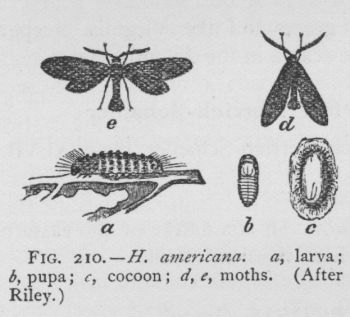
The habits of this insect have been so well described by Professor C. V. Riley that we cannot do better than quote some passages from his account, which is to be found in the "Second Annual Report of the State Entomologist of Missouri," at page 85. He says: "During the months of July and August, the leaves of the grape-vine may often be found denuded of their softer parts, with nothing but the veins, and sometimes only a few of the larger ribs left skeleton-like, to tell the mischief that has been done. Very frequently only portions of the leaf will be thus denuded, and in that event, if we examine such a leaf closely, we shall find the authors of the mischief drawn up in line upon the yet leafy tissue with their heads all toward the margin, cutting away with their little jaws and retreating as they feed.
These soldier-like files are formed by worms in black and yellow uniforms which produce a moth popularly known as the American Procris. The eggs from which they hatch are laid in small clusters on the under side of the leaves, and while the worms are small, they leave untouched the most delicate veins of the leaf, which then presents the appearance of fine network, as shown in the right of the figure (211); but when they become older and stronger they devour all but the larger ribs, as shown at the left of the figure. . . . When full grown these worms disperse over the vines or forsake them entirely, and each spins for itself a small, tough, whitish, flattened cocoon, within which, in about three days, it changes to a chrysalis, three tenths of an inch long, broad, flattened, and of a light shining yellowish-brown color. In about ten days afterwards the moths begin to issue."
The insect is double-brooded. It is common in the Appalachian subregion, ranging from the Atlantic to the borders of the Great Plains in the West.