Home › Volumes › Moths › Geometer Moths
Gooseberry Span-worm
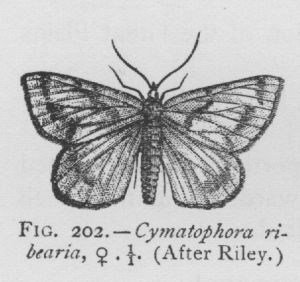
The gooseberry and the currant are subject in the United States and Canada to the attack of various insects, which do a great deal of damage to them. One of the most frequent causes of injury to these plants are the larvae of the Gooseberry Span-worm, which is represented in Fig. 204. It is, when mature, about an inch in length, bright yellow in color, marked with dark-brown spots upon the segments. The eggs, which are laid by the mature female at the end of June or the beginning of July, are very minute, but upon examination under the microscope are seen to be beautifully ornamented with deep pits or sculpturings. They are pale bluish-green. The eggs are attached by the female to the stems and branches of the plants, not far from the ground. Being almost microscopic in size, they readily elude observation, and this, it is known, accounts for the fact that the insects are often, by the transplantation of the shrubs, transferred from one locality to another in which they have been previously unknown. The eggs, having been laid, remain through the summer and fall and all of the succeeding winter in a dormant state, and do not hatch until early in the following spring, when the leaves are beginning to put out upon the bushes. As soon as the eggs are hatched, the larvae begin to feed upon the young leaves, and they mature very quickly, the rate of their development being marked by a corresponding devastation of the plants upon which they have established themselves. Pupation takes place at the end of May or in the beginning of June. The caterpillar burrows into the loose soil about the roots of the bushes, or simply crawls under loose leaves, and, without spinning a cocoon, undergoes transformation into a chrysalis, which is smooth and of a shining mahogany color. In this state the insects remain for about two weeks, when they emerge as moths, and the cycle of life is repeated.
The most effectual method of combating the larvae is to sprinkle the bushes with powdered white hellebore. This is a good remedy, not only for the species we are considering, but for several other insects which are likely to occur upon the plants at the same time.