Home › Volumes › Moths › Hawk Moths (Sphinx Moths)
Galium Sphinx
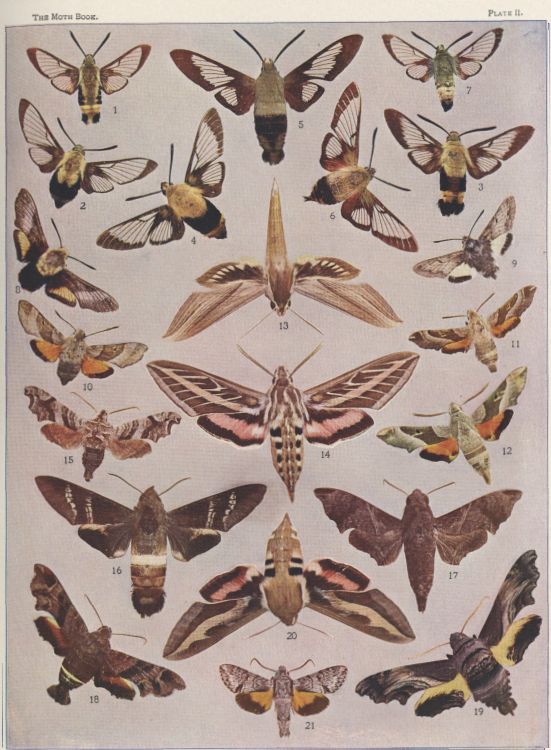
This hawkmoth, which is the North American representant of Celerio gallii, which is found all over the north temperate regions of the Eastern Hemisphere, ranges from Canada to Vancouver and southward through the mountains of the Appalachian System and along the higher plateaus and mountain ranges of the West as far as Central Mexico. I have specimens taken in the Sierra Madre of Chihuahua. The identification of the species may easily be made by means of the figure on our plate.
THE WORLD OF THE DARK
"... Sorrowing we beheld
The night come on; but soon did night display
More wonders than it veil'd; innumerous tribes
From the wood-cover swarm'd, and darkness made
Their beauties visible."
SOUTHEY.
There are two worlds; the world of sunshine, and the world of the dark. Most of us are more or less familiarly acquainted with the first; very few of us are well acquainted with the latter. Our eyes are well adapted to serve us in the daylight, but they do not serve us as well in the dark, and we therefore fail to know, unless we patiently study them, what wonders this world of the dark holds within itself. There are whole armies of living things, which, when we go to sleep, begin to awaken; and when we awaken, go to sleep. The eyes of the creatures of the dark are adapted to seeing with less light than our eyes require. The broad daylight dazzles and confounds them. Sunshine has much the same effect upon them that darkness has upon us. Our twilight is their morning; our midnight is their noonday.
This is true even of many of the higher vertebrates. The lemurs, which are a low family of simians, are nocturnal in their habits. So also is the Aye-Aye of Madagascar, and that curious little member of the monkey tribe known as the Specter (Tarsius spectrum). No one can see the great eyes of these creatures without realizing at a glance that they love what we call darkness better than what we call light, though they are far from being evil-doers. The great family of the cats are principally nocturnal in their habits. Their eyes are capable of being used in daylight, for the beautifully contracting and expanding iris modifies the amount of light admitted to the retina far more delicately and instantaneously than any device, attached to the most perfectly constructed camera, regulates the amount of light transmitted through its lens. The tiger in the jungle sees what is going on about him in the starlight as well as we see what is happening in the noontide. I have studied the eyes of lions and tigers in the dark. The yellowish-green iris in the night almost entirely disappears from view, and shrinks down into a narrow ring. The windows of the eyes have the curtains drawn back wide, so as to let in all the light which the darkness holds within itself. The great orbs then look like globes of crystal, framed in a narrow band of gold, lying on a background of the blackest velvet, while in their pellucid depths, fires, tinged with the warm glow of blood, play and coruscate.
The eyes of many birds are adapted to the dark. This is true, as everybody knows, of the owls, and of their not distant relatives, the goat-suckers. I remember having, when a boy, dissected an owl, which I found dead after a long protracted period of intensely cold weather. The thermometer had stood at twenty degrees below zero for several nights in succession. The earth was wrapped deep in snow. Upon the sleety crust I found a great horned owl, lying dead, and frozen stiff. It may have died of old age, or it may have starved to death. The instinct of the child, who takes his toys to pieces in order to see how they are made, seized me, and, with a sharp penknife as a scalpel, and a few needles set in sticks of pine, I took my owl apart, and made drawings of what I found. I did not then know the names and functions of all the parts, but the drawing of the eye, which I made, I still have in an old portfolio, and there I saw it the other day. The eye of an owl is a wonderful piece of mechanism. It is a wide-angle lens of beautiful powers of adjustment. It is adapted to taking in all the light there is, when the light is almost all gone; and it is so contrived as to shut out light, when too much of its splendor would dazzle and hurt.