Home › Volumes › Moths › Lichen Moths
Crimson-bodied Lichen-moth
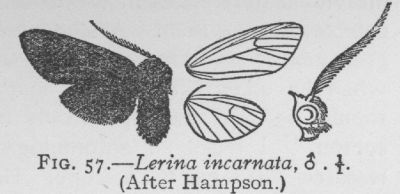
The head, tegulae,and patagia, with the terminal half of the abdomen are deep crimson. The rest of the body and its appendages are black. The wings are bronzy-green. The insect inhabits Mexico and southern Arizona.
"SPLITTERS" AND "LUMPERS"
Every true naturalist is called upon to exercise the faculty of discrimination and the faculty of generalization. His work trains him to detect dissimilarities on the one hand and likenesses on the other. His judgments as to likeness are expressed in the genera, the famiies, the orders, which he proposes. His judgment as to dissimilarities is most frequently expressed in his views as to species. When the two faculties of discrimination and generalization are well balanced and accompanied by the habit of patient observation, ideal conditions are reached, and the work of the naturalist in classification may be expected to stand the test of time. But where, as is often the case, one of these faculties is exalted at the expense of the other, there are certain to result perversions, which will inevitably cause trouble to other students. When a man cultivates the habit of discrimination to excess, he is apt to become, so far as his labors as a systematist are concerned, "a splitter." A "splitter" magnifies the importance of trivial details; he regards minute differences with interest; he searches with more than microscopic zeal after the little things and leaves out of sight the lines of general resemblance. Huber, the celebrated naturalist, said that by patient observation he had come to be able to recognize the different ants in a hill, and, as one by one they emerged from their subterranean galleries, he knew them, as a man living upon a certain thoroughfare in a great city comes at last to know by sight the men and women who are in the habit of daily passing his windows. No doubt the critical eye can detect as great individual differences in the lower animal world as are to be detected among men. A student comes to apply himself with great zeal to searching out and describing these differences, and when he undertakes to say that because of them one form should be separated specifically from another he becomes "a splitter." I recall an entomologist whose chief weapon of research was a big microscope. He would take a minute insect and study it until he was able to number the hairs upon its head. Then he would describe it, giving it a specific name. The next specimen he would subject to the same critical process, and if the number of hairs was not just the same, or a small wart was detected here or there, or a bristle grew in a place where a bristle did not grow in the specimen previously examined, it too, was described and a specific name was given it. It was as if a man, sitting and looking out on the throng upon Broadway, should resolve to give every individual a specific name and should declare he had seen as many species of men as he had seen men passing his window. The labors of such naturalists may be highly entertaining to themselves, but they are, to say the least, provocative of unpleasant feelings in the minds of others who come after them and are compelled to deal with and review their labors.
The "lumper," on the other hand, is a man who detects no differences. "All cocoons look alike to me!" he says. Any two moths which are of approximately the same size and the same color, are, by him, declared to belong to the same species. Questions of structure do not trouble him. General resemblances are the only things with which he deals. No matter if eggs, larvae, legs, veins, and antennae are different it is "all one thing" to him. His genera are "magazines," into which he stuffs species promiscuously. The "lumper" is the horror of the "splitter," the "splitter" is anathema to the "lumper"; both are the source of genuine grief and much hardship to conscientious men, who are the possessors of normally constituted minds and truly scientific habits. Nevertheless, we are certain to have both "splitters" and "lumpers" in the camps of science until time is no more. "This kind goeth not forth" even for "fasting and prayer."
"Look at this beautiful world, and read the truth
In her fair page; see every season brings
New change to her of everlasting youth--
Still the green soil, with joyous living things
Swarms--the wide air is full of joyous wings."
BRYANT.