Home › Volumes › Moths › Tortricidae Family
Coddling-moth
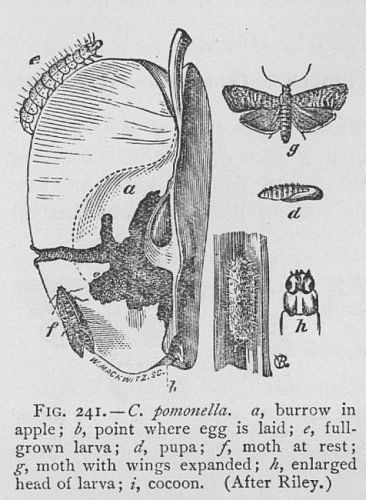
This well-known and most destructive little insect is estimated to inflict an annual loss upon the fruit-growers of America which amounts in the aggregate to tens of millions of dollars. Every one is familiar with the pinkish worm which is encountered at the heart of apples and pears. But for every apple and pear which survives the attacks of these insects and develops sufficiently to come to market and to the mouth of the consumer, there are scores of apples and pears the development of which is entirely ruined, and they fall to the ground undersized and worthless. There are two broods of the insects annually. The second brood hibernates in the cocoon. We quote again from Riley: "The same temperature which causes our apple-trees to burst their beauteous blossoms releases the coddling-moth from its pupal tomb, and though its wings are still damp with the imprint of the great Stereotyping Establishment of the Almighty, they soon dry and expand under the genial spring-day sun, and enable each to seek its companion. . . . The moths soon pair, and the female flits from blossom to blossom, deftly depositing in the calyx of each a tiny yellow egg. As the fruit matures, the worm develops. In thirty-three days, under favorable circumstances, it has become full-fed; when, leaving the apple, it spins up in some crevice, changes to a chrysalis in three days, and issues two weeks afterwards as moth, ready to deposit again, though not always in the favorite calyx this time, as I have frequently found the young worm entering from the side."
The best remedy for the coddling-moth is to destroy all windfalls and immature fruit lying upon the ground. Make it a duty to keep the wind-fallen fruit garnered up once a week and fed to the pigs. Let the pigs into the orchard, if possible. Bind bands of hay about the trees. The caterpillars will form their cocoons among the hay in preference to any other place. Once a week crush the hay with the cocoons in it, and move the band up and down. Burn the wisp of hay if it gets full of cocoons, and bind on another. The coddling-moth is an importation from Europe. Not all the live stock brought into America from Europe, biped or hexapod, has turned out well.