Home › Volumes › Moths › Owlet Moths
Catocala Amica
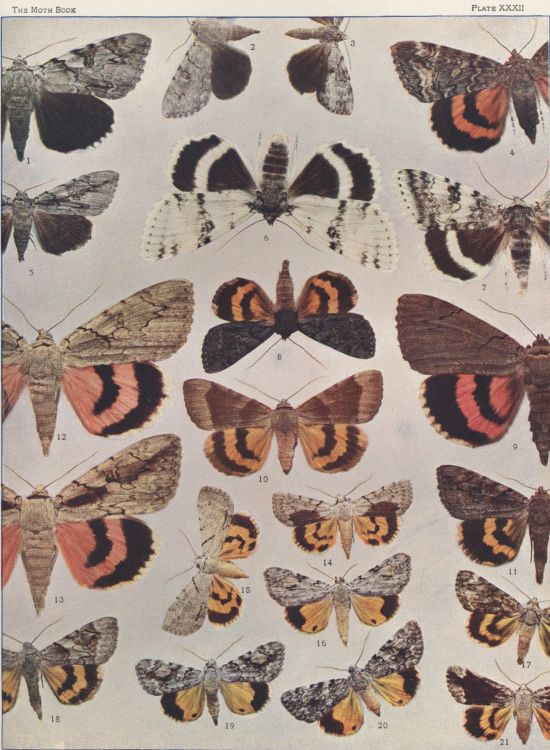
Form lineella Grote, Plate XXXII, Fig. 19, male.
Form nerissa Henry Edwards, Plate XXXII, Fig. 20, female.
This small species is subject to considerable variation. It has a wide range from Ontario to Texas, and from the Atlantic to the Great Plains.
"Place and time requiring, let this insect fly. It hovers round the wick-with the wind of its wings the flame is extinguished."
Sudraka, The Mrichchakati, or, The Toy-cart.
WALKING AS A FINE ART
THE first act of all animals is that of absorption. Feeding is a primal necessity. The senses of smell, of touch, and of taste are involved in it. Sight has little to do with it at first, but is soon awakened. Coincident with this act among the lower animals is that of locomotion. Man, whose desire to annihilate space has become a supreme passion, approaches the act of locomotion later than all other animals. Young ducks and geese fly from the Arctic Circle to Florida a few months after they have been hatched. Babies do not often begin to crawl until they are twice as old, and rarely walk until more than a year of life has been passed. There is nothing more interesting than the sight of a child just beginning to walk. The look of glad surprise and immense satisfaction which is displayed when a few successful steps have been taken is delightful to the observer. The triumphs of the most successful men do not in later years afford them so much momentary pleasure as is experienced by the little fellow who realizes that at last after many failures he has "got his legs."
In much of our going to and fro on this small globe we are aided by adventitious helps. Stephenson, Fulton, and the fathers of the science of magnetism and electricity have done much to pave the way for our rapid transportation from one spot to another. But there are some places to which we cannot be hauled, and we have not yet reached the point where we can dispense with the use of our pedal extremities.
Happy is the man who has acquired the love of walking for its own sake! There is no form of exercise more health-giving, none which tends more thoroughly to invigorate, if it be wisely undertaken. The effect of the act is to quicken the venous circulation; to send the blood to the lungs, there to be purified by contact with the oxygen of the atmosphere; to harden and strengthen the muscles of the legs and to bring those of the arms and the chest into play. People who walk do not have overloaded veins. The shop-girl who stands behind the counter all day suffers from varicosis, but the man or woman who walks avoids it. Standing is harder than walking; it is more fatiguing, and brings no return of health to the system.
In walking, the best results are secured when there is no burden upon the mind. The man who carries the load of daily care with him when he walks derives less benefit from the act than the man who dismisses all concern and simply gives himself over to the act. It is a mistake to suppose that it is an advantage in walking to have some definite object of pursuit. The woman who is advised by her physician to walk should not select as her path some busy street upon which she is certain to be diverted by the opportunity to unite with her exercise a number of shopping excursions. The man who goes out to walk should not choose a much frequented part of the town where he is sure to meet business friends and acquaintances. The person who desires to derive the best results from his strolls should select a retired spot in park or country where the "madding throng" does not resort. It is hard to make Americans realize the importance of these suggestions. The demand is forever that exercise, if taken at all, shall have an aim ulterior to itself, in the pursuit of which the upbuilding of the system shall take place as a collateral incident. The popularity of golf is due to the fact that it answers the demand of a great class of persons to be amused while they are being invigorated. It is one of the least objectionable forms, in which the pill of exercise is sugarcoated for consumption by a race which is slowly but surely working itself to death in office, mill and factory.
Walking for its own sake is pursued to a far greater extent in England and in Germany than in America. We may well learn to imitate our cousins on the eastern side of the Atlantic in this regard.