Home › Volumes › Moths › Tineidae Family
Carpet-moth
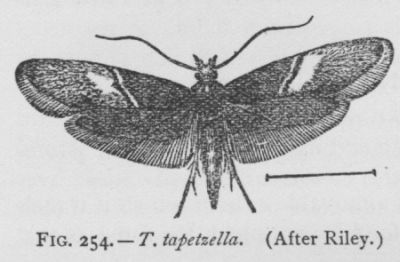
The nature and habits of this species are very closely allied to those of the last two species of which we have spoken. Like them, it was originally introduced into America from the Old World. It differs from them in the larval state in that, instead of simply making a cocoon for itself out of bits of hair as the Clothes-moth, or forming a movable case for itself as the Fur-moth, it weaves together, out of the debris of the material in which it is carrying on its ravages, long galleries lined inside with strands of silk. These long, tortuous galleries, cut through the pile of carpets, are familiar objects to the careful housewife, whose horror and anxiety have often been expressed to the writer. It is one of the sad prerogatives of the entomologist to be made from time to time the recipient of the household woes of his neighbors, who discover that the moth and the buffalo-bug "corrupt," and that the white ant and the cockroach "steal."
The perfect insect, as shown in the annexed cut, is in appearance a very different moth from either of the foregoing species.
CLOTHES-MOTHS
"The moth shall eat them up like a garment, and the worm shall eat them like wool."
ISAIAH.--LI, 8.
From the accounts which have been given in the preceding pages of the three species of Clothes-moths, the ravages of which are commonly encountered in the household, it has been learned that they may each be discriminated from the other by the habits of the larvae. The Carpet-moth makes a gallery of the substance on which it feeds; the Fur-moth makes a small portable case, which it carries with it; while the insect which we have called the Clothes-moth lives for the most part free until the time of pupation, when it constructs for itself a cocoon out of bits of fiber.
All of these three species are equally destructive, and there is no question which is more frequently asked of the writer than how best to destroy the insects when once they have found lodgment in a house, and how to prevent their attacks.
All of these creatures "love darkness better than light, their deeds being evil." When it is suspected that furs or garments are infected by their presence, the first step which should be taken is to expose them to full sunlight, the hotter the better. Garments in which moths are known to exist should be hung up in the open air. And this airing and exposure to sunlight should not be for an hour or two, but, if possible, it should extend over a number of days, and should take place in the latter part of May or the early part of the month of June, at which time the female moth is engaged in ovipositing. Where it is impossible to air and expose to sunlight the fabrics which have been attacked, as is sometimes the case with carpets in dark corners, they should be thoroughly saturated with benzine. It is needless to say that this operation should never be undertaken in the presence of a candle or other exposed light. Furniture in carpeted rooms should in the spring of the year be removed from the place where it has long stood, and the spot should be thoroughly sponged with benzine. A solution of corrosive sublimate in alcohol, so weak that it will not leave any white mark upon a black feather which has been dipped into it and afterward dried, may be applied effectively to carpets and to fabrics which are exhibited in museum cases. At the Carnegie Museum we make it a rule to spray all substances which might be exposed to the attack of moths, when hung in cases, with a solution of corrosive sublimate and strychnine in alcohol.
In carpet warehouses and in establishments where woolen goods are stored in quantity it is well to have on the roof of the building an apartment fitted up with large air-tight chests. Into these chests, or compartments, fabrics supposed to have been attacked by moths may be put and exposed for twenty-four or, more hours to the fumes of carbon bisulphide. This fluid should be placed in large quantity in shallow pans at the bottom of the disinfecting-chambers, in such a way that it will not come directly in contact with the fabrics. Being volatile, the fumes will gradually fill the entire chamber, and will destroy all animal life. Inasmuch as carbon bisulphide, as has already been stated elsewhere in this book, is, when mixed with atmospheric air, highly explosive, no lights should be allowed to come near the chests, or the apartment in which the disinfection is taking place. The writer has in his own household made it a rule in the spring of the year to take all rugs and have them placed in a large chest about four feet long, three feet wide, and three feet deep, at the bottom of which there is a slatted support beneath which is a long, shallow pan. Into this pan the bisulphide is poured. The rugs are loosely placed in the chest, and then it is closed tightly and they are left there for forty-eight hours.