Home › Volumes › Moths › Owlet Moths
Boll-worm
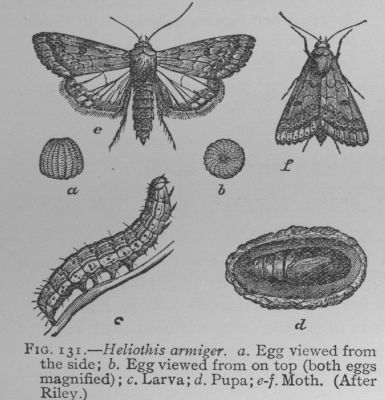
This insect, which is known to English entomologists as the "Scarce Bordered Straw," is unfortunately not scarce in the United States, and being of a singularly gluttonous habit in the larval stage, has become the object of execration to farmers and horticulturists. It is a very promiscuous feeder, but shows a special fondness for young Indian corn in the ear and for cotton bolls. On account of the latter peculiarity it has received the name we have applied above. It attacks the fruit of the tomato when still green, and causes it to rot on the vines. It also feeds upon pumpkins, peas, beans, hemp, and, it is said, upon tobacco.
An excellent account of its habits has been given by Prof. C. V. Riley in his "Third Annual Report" as State Entomologist of Missouri. It is from that paper that we have extracted the figures, which are herewith given, and which serve to illustrate the life-history of the insect. The moth ranges all over the United States and southern Canada. It is most abundant in the southern portion of our territory, where there are from three to four broods annually. It is here in the cotton-fields and in the growing corn that the greatest damage is inflicted. There appears to be no way of applying remedies in a wholesale manner to the crops so as to prevent the depredations of this insect. The only resort is for the grower to go carefully over the fields, and where he detects the presence of the insects in their early stages, to pick them off and destroy them. In the case of corn the presence of the worm is shown by the premature drying of the silk, and in the case of cotton by the fallen flower-buds, which lie withering on the ground.