Home › Volumes › Moths › Tineidae Family
Bogus Yucca Moth
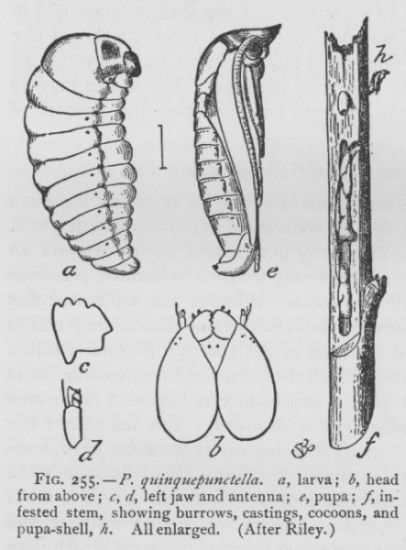
This little moth, which superficially resembles Pronuba yuccasella, has no maxillary tentacle such as is found in the latter insect. Its absence is characteristic, in fact, of all the species of the genus. The ovipositor is homologous to that of Pronuba, but is a stronger instrument intended for making incisions in the tender bark of the stem, while the ovipositor of Pronuba is a long, slender organ which is used to thrust the egg into the ovarian cavity of the growing seed-vessel.
The larvae of the various species of Prodoxus are without feet, quite maggot-like, and remain in their burrows in the stems of the Yucca plants, not descending to the ground to pupate, as do those of Pronuba. The pupae, when the time for emergence arrives, protrude themselves from the stems, and the moth escapes from the pupal skin, very much in the way in which the same act is performed by various species of wood-burrowing AEgerians. The cut, Fig. 255, taken from the writings of Professor C. V. Riley, has more value as an explanation of the facts in the case than a whole page of verbal description would have. The species of the genus Prodoxus all appear upon the wing before those of the genus Pronuba, the former having no function to perform in connection with the fertilization of the flowers, and being on the spot to oviposit while the flower-stems are still soft and easily capable of being cut into by the ovipostor of the female, while Pronuba must wait until the flowers are opening and the tissues of these portion of the plant are ready for the peculiar operations which the perpetuation of the life both of the plant and the insect call for.