Home › Volumes › Fishes › The Whitefish, Salmon and Trout
Utah Trout
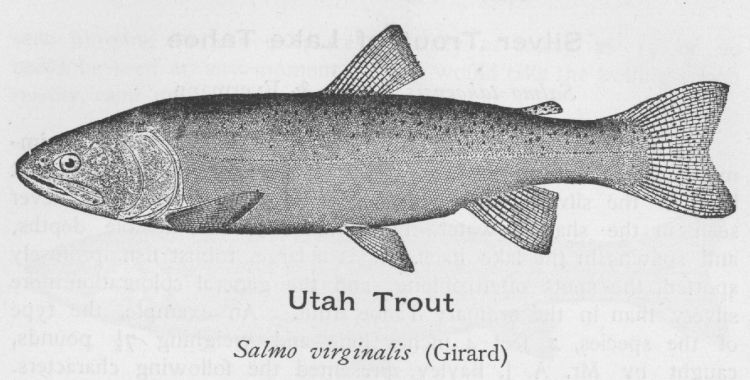
In all suitable streams and lakes of the old Lake Bonneville basin, of which the waters of the Great Basin are the present vanishing remnants, is found a trout which is profusely and finely spotted, the spots being numerous anteriorly as well as posteriorly; scales a little larger than usual, in 140 to 150 lengthwise series, and anteriorly less crowded than in the trout of the Rio Grande, or in the green-backed trout. In partly alkaline waters, such as in Utah Lake, this trout reaches a very large size, examples of 8 to 12 pounds being not uncommon. In these waters it is very pale in colour, the dark spots being few and small, and mostly confined to the back.
The Utah trout is found in the streams and lakes of Utah west of the Wasatch Mountains, especially in Bear, Provo, Jordan and Sevier rivers, and in Utah Lake, where it is a very abundant and important food-fish.
Jordan's Trout; Spotted Trout of Lake Southerland
Salmo jordani Meek
In Lake Southerland, west of Puget Sound, is found a black spotted trout of the cut-throat series which, in colour, seems to resemble the Utah trout. It is, according to Professor D. G. Elliot, a "beautiful and exceedingly gamy trout, taking the fly readily even as late as October, a great leaper when hooked, and fights a l'outrance. In appearance it resembles Salmo gairdneri crescentis of the neighbouring lake, being fully as brilliantly coloured, but can be at once distinguished by its orange or orange-red fins, red on the jaw, the number and blackness of its spots, and the darker back and top of head. At no stage of its existence that I have seen, from fingerlings to fish weighing over 4 pounds, is there any silvery lustre, but the colours are all bright-hued, some even metallic. It is one of the most attractive of its tribe, and I have had them leap after taking the fly, in such rapid succession and with such dartings about the lake, that it was impossible to imagine where they would next appear. I believe it spawns in the spring, as in the middle of October, the eggs of the females we caught were not enlarged, and showed no indication of the approach of the spawning season."
Head 3 7/8; depth 4 4/5; eye 5 7/8; snout 4 1/8; maxillary 1 3/4; scales 146; D. 10; A. 11; Br. 10 or 11. Body elongate, not much compressed; head short, maxillary not extending far beyond orbit; origin of dorsal fin midway between tip of snout and base of caudal.