Home › Volumes › Fishes › The Minnows
Utah Lake Chub
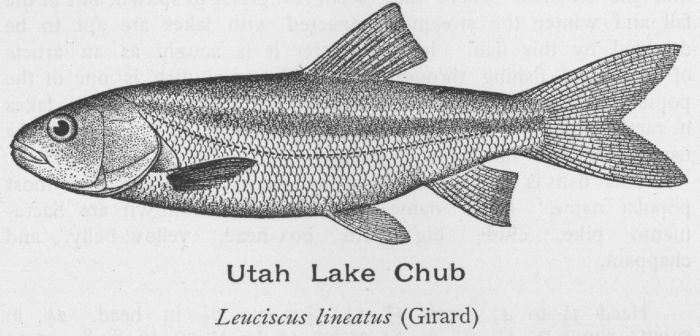
Head 3 1/2; depth 3 1/2; eye 7; D. 9; A. 8; scales 10-55 to 65-5; teeth 2, 5-4, 2, short and stout, one of them with grinding surface. Body robust, elevated anteriorly, the sides compressed, although the back is very broad; head broad, the interorbital space flattish; adult with the profile concave, straight or convex in the young; snout broad, elevated at the tip; premaxillary on level of pupil; mouth very oblique, the mandible projecting; maxillary reaching front of eye; scales large, sub-equal, broadly exposed, firm; lateral line decurved; dorsal nearly median, inserted directly over ventrals; caudal evenly forked, the peduncle long and deep; pectoral short, reaching 3/5 distance to ventrals; ventrals about reaching vent. Colour, dark the scales much dotted, the edges quite dark, often forming lines along the rows of scales. Length 12 to 15 inches.
One of the largest and most widely distributed species of the genus, abundant everywhere in the Great Basin of Utah, and in the Snake River basin above Shoshone Falls. In Utah Lake it is exceedingly abundant, as it is also in Jacksons Lake, Yellowstone Lake and other similar waters, where, owing to its large size, it is of some importance as a food-fish. It is said to be very destructive to the eggs of trout, a belief which may be justified by the facts, but we are not aware that matter has ever been fully investigated.
Besides this species of Leuciscus there are in America about 24 other species, all of which are small and of little importance except as boy's fishes. With a few exceptions they are species of the Western States, and are perhaps most valuable to the Indians or in those regions where better fish are rare.
Then in Lake Tahoe, the Klamath Lakes, and various other lakes of Nevada, California and Oregon are found three species of the genus Rutilus, closely related to Leuciscus, none of them of much food value.