Home › Volumes › Fishes › The Minnows
Squawfish
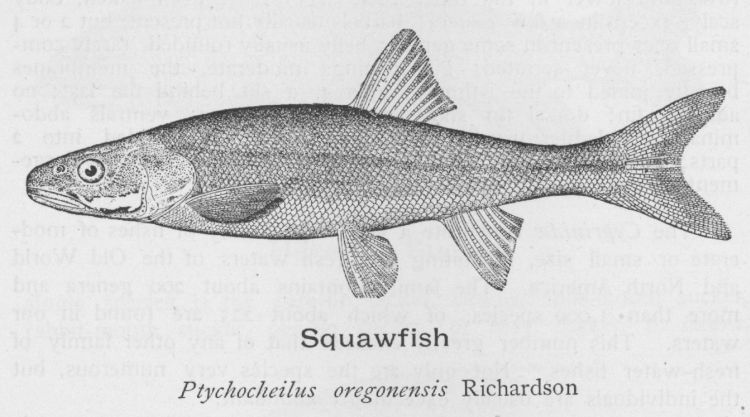
The squawfish is one of the largest of the minnows. It reaches a length of 2 to 4 feet, a size which shows strikingly that "minnows" are not necessarily little fish.
Its geographic range is from British Columbia southward in Pacific Coast drainage to central California. In the Columbia River basin it ascends as far as Shoshone Falls in Snake River, and at least to Flathead Lake in Clarks Fork. It is abundant in the Fraser, and also in the Sacramento, San Joaquin, Salinas, and other lowland streams of California. It is very abundant in the Redfish Lakes, and other lakes of Idaho. During the fall and the latter part of summer large schools of this species could be seen, particularly in the evening, swimming about the mouths of the inlets, usually at a depth of 5 to 40 feet, but toward evening they would come to the surface and feed greedily upon various insects that had fallen upon the surface of the water. Their manner of taking these insects is very much like that of the trout. Frequently they would jump entirely out of the water in their eagerness to secure the falling insect. They will rise to the artificial fly quite freely. By using Royal Coachman and fishing as if for trout excellent sport may be had. They rise to the fly promptly, strike quickly, and fight vigorously for a few moments, after which they allow themselves to be pulled in without much struggle. They will rise to the fly best in the evening, but will at any time take the hook baited with salmon spawn.
During the spring and early summer the Squawfish run out into the streams, where they seem to prefer to spawn, but in the fall and winter the streams connected with lakes are apt to be deserted by this fish. In the winter it is sought as an article of food, and fishing through the ice for squawfish is one of the popular winter amusements at the Idaho lakes. In these lakes it rarely attains a greater weight than about 4 pounds, and the usual weight is not over a pound.
This fish is highly esteemed by the Indians, hence its most popular name. Other names by which it is known are Sacramento pike, chub, big-mouth, box-head, yellow-belly, and chappaul.
Head 3 1/2 to 4; depth 4 2/3 to 5 1/2; eye 7 1/2 in head, 2 1/2 in snout; snout 3; D, 9; A. 8; scales 15 to 17-70 to 80-8, 42 to 60 before the dorsal; teeth 2, 4-5, 2, strong and well hooked, but without grinding surface. Body rather robust, with stout caudal peduncle; head long and pointed; mouth large, the maxillary reaching front of pupil; eye small, much larger in the young; lateral line strongly decurved, much nearer belly than back. Colour, muddy, greenish above, sides somewhat silvery, but chiefly dirty yellowish; belly yellowish or pale; in spring the fins are reddish or orange and the scales more or less dusted with dark specks; young with a black caudal spot.