Home › Volumes › Fishes › The Whitefish, Salmon and Trout
Sebago Salmon
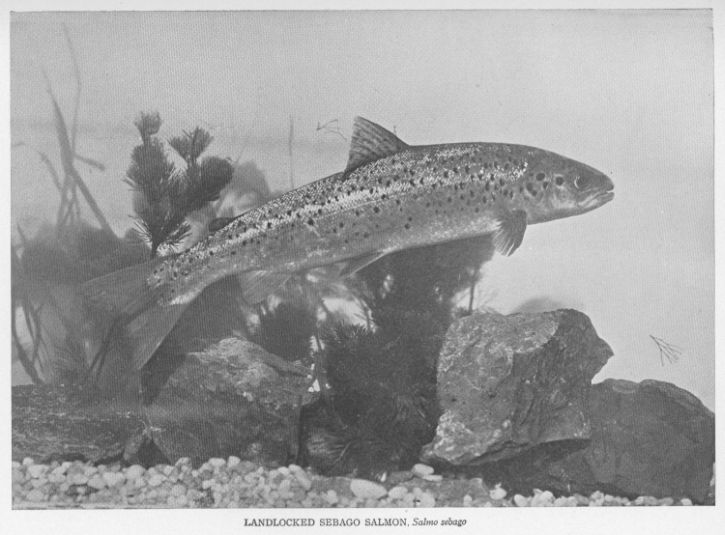
The sebago salmon receives this name from Sebago Lake, the locality from which it was first described. It originally occurred in 4 river basins in Maine and perhaps in a few lakes in the British Provinces.
In Maine the original habitats were Presumpscot River or Sebago Lake basin, Union River or Reeds Pond (now known as Green Lake) basin, Sebec Lake basin and St. Croix River basin which includes the Schoodic Lakes from which the fish derives also the name of "Schoodic salmon"; but it is more commonly called landlocked salmon.
By fish-cultural operations it has become pretty widely distributed, especially in New England and in New York.
As a rule it differs from the sea salmon in the smaller size, rather plumper form, much harder skull-bones, larger scales and different colouration.
The Sebago Lake salmon originally attained the largest size, the Green Lake next, followed by the Sebec Lake, those of Grand Lake of the Western Schoodic Chain being the smallest.
This condition obtains in part to the present day. At least the Sebago Salmon are the largest and the Grand Lake salmon the smallest of the 4 original regions. Though the stocks of Sebec, Sebago and Green lakes have been perhaps, adulterated by introduction of salmon from other waters, that of Grand Lake has been maintained in its primal integrity.
The salmon of Grand Lake seldom exceed a weight of 5 pounds or average more than 2 pounds.
In the fall of 1901, among many salmon taken in the weir at Sebago Lake, for fish-cultural purposes, were one of 23, many of 15 pounds and over, and the average was about 10 pounds.
The habits of the fish are apparently almost in every particular analogous to those of the sea salmon, modified more or less by physical conditions. In Sebago Lake, in the fall, structural and chromatic changes occur, and it ascends tributary streams to spawn. After this function is performed it returns to the lake, which is its ocean, and resorts to deep water.
In the spring, as soon as the ice breaks up, when smelts, upon which it extensively feeds, are running up the streams to spawn, the salmon follow them to the shore and up the larger streams and descend with them. During summer they remain in deep water, though they occasionally appear at the surface coincidently with the surface schooling of smelts.
As a game-fish it ranks high but is reputed to be inferior to the ouananiche of the Grand Decharge.
In lakes it undoubtedly possesses these qualities to a less degree than the ouananiche of the turbulent waters of the Grand Decharge. But this is not due to inherent inactivity but to external conditions.
Rushing waters, single hook and light tackle are 4/5 of the game qualities of any fish.
The customary angling appliances on Sebago Lake are a stiff rod, a derrick-like reel, a phantom minnow, archer spinner or murderous gang, all of which, combined with the quiet lake or still waters of Songo River, disincline the fish to prolonged antagonism. But let the angler use a light rod, single baited hook or artificial fly in the quick waters of the Presumpscot River or Grand Lake stream, and he will find at least an epitome of the Grand Decharge.