Home › Volumes › Fishes › The Surmullets
Red Goatfish; Salmonete
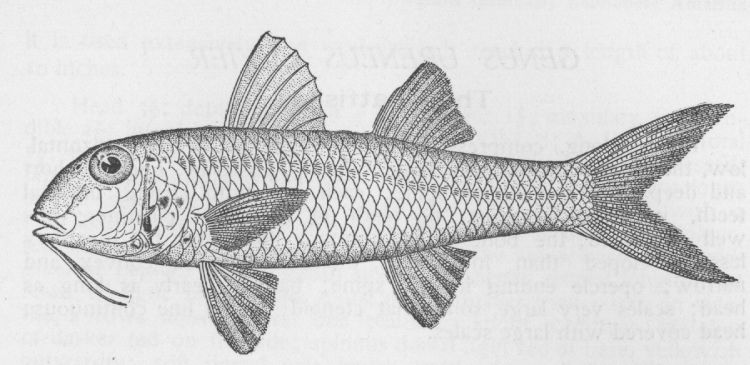
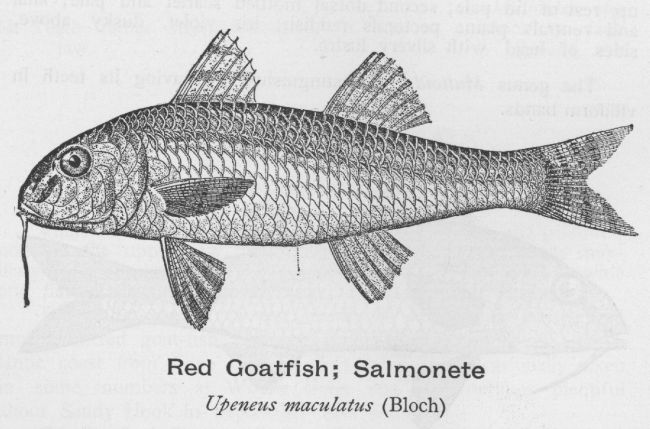
Generally common from Rio Janeiro through the West Indies to Key West. It occurs in abundance about Porto Rico where it is used extensively as a food-fish. It reaches a length of about 10 inches.
Head 3 1/5; depth 3 7/10; eye 4 to 5; snout 1 4/5; maxillary 3 1/5; mandible 2 2/5; interorbital 3 2/3; preorbital 3 1/3; D. VII-I, 8; A. II, 7; pectoral 1 1/2; ventral 1 2/5; caudal 1 1/3; scales 3-30-5. Body little compressed, tapering posteriorly to the long caudal peduncle; snout very long; mouth small, maxillary not nearly reaching eye; throat with 2 long barbels, reaching to margin of preopercle or beyond. Colour, red above, merging into light yellow on the sides, becoming palegreenish below; oblique bluish streaks on head; several longitudinal rows of light blue round spots, much smaller than pupil, on side, the 2 rows above lateral line plainest; about 4 diffuse blotches of darker red on the side; spinous dorsal light red at base, yellowish outwardly; soft dorsal pale bluish, with some light yellow on membranes and red on middle rays; pectoral chiefly yellow, with red on rays; ventrals pale blue, with streaks of red and yellow on first rays; barbels pink near base, yellow distally.
Upeneus dentatus is a rare species known only from Cape San Lucas, La Paz, Guaymas, and Tres Marias Islands. Colour, dusky above, sides bright rosy, a broad red band extending from eye to caudal. It reaches a foot in length.
Upeneus parvus is another rare species, known only from Cuba. Colour, vermilion above, fading to white below; a yellow band along side, with similar narrower streaks below; ventrals and anal yellow; other fins pale, with dusky cross-bands, 3 on first dorsal, 2 on second, and 5 on each caudal lobe.