Home › Volumes › Fishes › The Parrot-fishes
Parrot-fishes
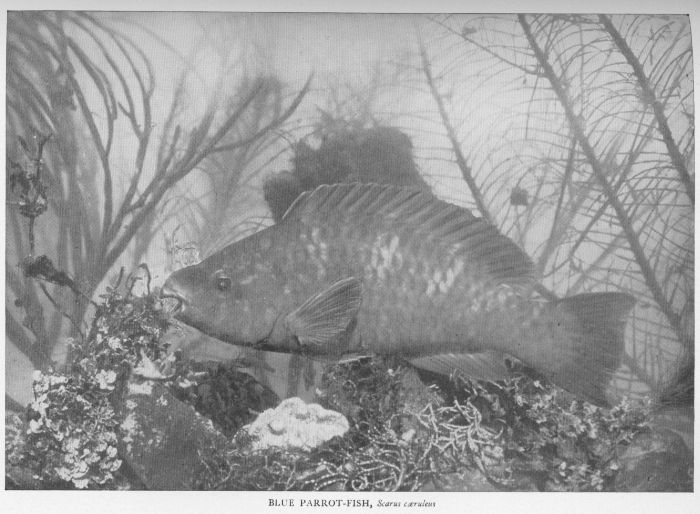
BODY oblong, moderately compressed, covered with large cycloid scales; mouth moderate, terminal; teeth in the jaws more or less coalescent at least at base; lower pharyngeals much enlarged, united in a concave or spoon-shaped body, their teeth broadest transversely, and truncate, arranged in mosaic; dorsal continuous, its formula usually IX, 10; anal II, 9; 23 to 25 scales in the lateral line. Sexes similarly coloured, the colouration almost always brilliant.
This is a large family with some 7 genera and more than a hundred species, often of large size, and all are herbivorous and inhabitants of warm seas. The smaller species are found among the algae in shallow water on sandy shores. Some of the larger ones are found about coral reefs and rocks. The flesh of these fishes is soft and pasty and they are not with us regarded as possessing any food-value. In the West Indies, however, they are utilized to some extent, particularly by the Tortola fishermen who fish about the east end of Porto Rico, where they catch several large species of this family in traps.
Among the natives of the Hawaiian Islands these fishes are highly esteemed. Several species of Scarus occur there, known by the natives as lauia, palukaluka, uhuula, etc., and they are eaten raw by the natives who pay very high prices for them.
The species of this family possess no game-qualities and are of so little food-value in the United States that we shall treat them very briefly.
The genus Sparisoma is a large one with about 18 species, all but one confined to our waters. They are nearly all of small size, showy colouration and, with few exceptions, of no food-value. The only ones deserving mention here are the following: Sparisoma abildgaardi, the red parrot-fish or loro colorado, reaches a foot or more in length. It is found among the West Indies and south to Brazil. It is common about Porto Rico where it is eaten.
S. chrysopterum, the loro verde, cotoro verde, or blue parrot-fish, is known from Brazil and most of the West Indies, It is common about Porto Rico where it reaches a good size and has some value as a food-fish.
S. lorito, the loro, occurs among the West Indies and southward. Obtained by us in Porto Rico, where it is used as food.
S. viride, also known as the loro verde, cotoro, or dark-green parrot-fish, is another West Indian species ranging north to the Bahamas and the Florida Keys. It is common about Porto Rico where it is a food-fish of some value. It reaches 2 feet in length. While all of these species of "loros" or "cotoros" are utilized by the Tortola and St. Thomas fishermen frequenting the grounds about the east end of Porto Rico, they are not so much used in Porto Rico.