Home › Volumes › Fishes › The Whitefish, Salmon and Trout
Oquassa Trout; Blueback Trout
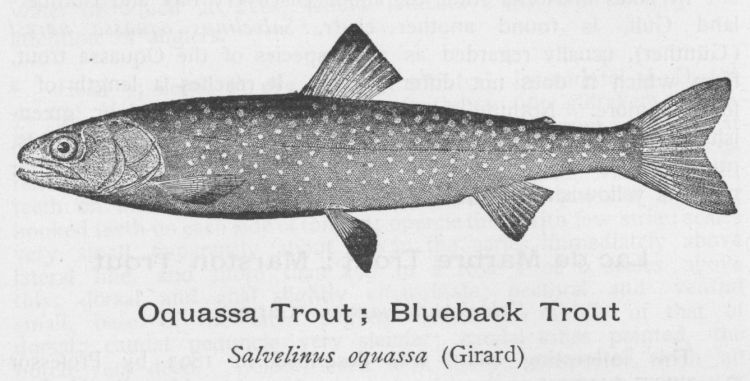
The blueback trout is the smallest and one of the most handsome of the charrs. It rarely exceeds a foot in length and a few ounces in weight, and is known only from the Rangely Lakes in western Maine. Although quite different in appearance, it shows no important structural differences separating it from the European saibling.
Formerly this fish was very abundant, running up the streams in October in immense numbers--running up at night and dropping back before morning, so that none was to be seen in the day time. Then the fish were small, only 6 to 10 inches in length, and 4 to 6 to the pound. Now they are very scarce, and the few that are caught are much larger, sometimes weighing as much as 2 1/2 pounds.
Head 5; depth 5; eye 3 1/2; D. 10; A. 9; scales about 230; gillrakers about 6+11. Body elongate, considerably compressed, less elevated than in the other species of charrs, the dorsal outline regularly but not strongly curved; head smaller than in any other trout, its upper surface flattish; mouth quite small, the maxillary short and moderately broad, scarcely reaching posterior edge of orbit; jaws about equal; scales small, those along the lateral line somewhat enlarged; pectoral and ventral fins not elongate; caudal fin well forked, in small ones more so than in other species, but more nearly "square" in large individuals; no concentric striae on opercles. Colour, dark blue, the round red spots much smaller than the pupil, and usually confined to the sides of the body; sides with traces of dark bars; lower fins variegated, as in S. fontinalis.
In lakes of Arctic America, about Discovery Bay and Cumberland Gulf, is found another charr, Salvelinus oquassa naresi (Gunther), usually regarded as a subspecies of the Oquassa trout, from which it does not differ greatly. It reaches a length of a foot or more. Nothing is known of its habits. Colour, greenish above, sides silvery or deep red, with very small red spots, much smaller than the pupil; lower fins deep red, the anterior margins yellowish white; dorsal fin reddish posteriorly.