Home › Volumes › Fishes › The Pikes
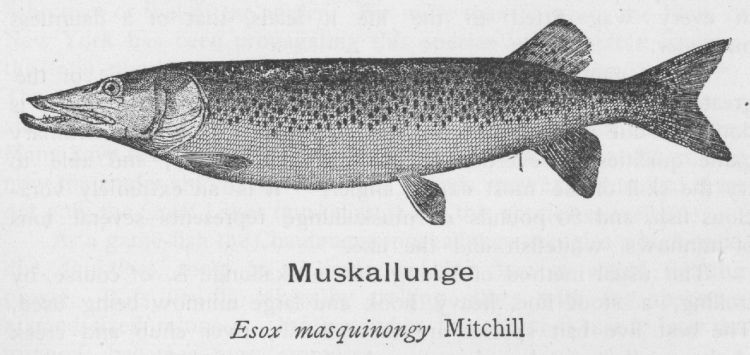
Muskallunge
Whence and what are you, monster grim and great?
Sometimes we think you are a "Syndicate,"
For if our quaint cartoonists be but just
You have some features of the modern "Trust."
A wide, ferocious and rapacious jaw,
A vast, insatiate and expansive craw;
And, like the "Trust," your chiefest aim and wish
Was to combine in one all smaller fish,
And all the lesser fry succumbed to fate,
Whom you determined to consolidate.--Wilcox.
The muskallunge is native to all the Great Lakes, the upper St. Lawrence River, certain streams and lakes tributary to the Great Lakes, and in a few lakes in the upper Mississippi Valley. It also occurs in Canada north of the Great Lakes. It does not seem to be at all abundant anywhere, as the number taken each year in any one of the lakes is small. It is perhaps most common in Lakes Michigan and Erie, and among the Thousand Islands.
This species is known by many different common names, most of them being variant spellings of the Indian name "noscononge." Among those which deserve mention are: muskallunge, muscalonge, muscallonge, muscallunge, muskellunge, musquellunge, masquinongy, maskinongy and great pike. Muskallunge is the spelling which now seems to be most usually followed.
The muskallunge reaches a length of 8 feet, and is a magnificent fish, by far the largest of its family, reaching a weight of 100 pounds or more. "A long, slim, strong and swift fish, in every way fitted to the life it leads, that of a dauntless marauder."
As a game-fish the muskallunge is regarded as one of the greatest, though the interest in catching a fish of this species is doubtless due more to its immense size than to any extraordinary game qualities. Nevertheless, it is a good fighter, and able to try the skill of the most expert angler. It is an extremely voracious fish, and 80 pounds of muskallunge represents several tons of minnows, whitefish and the like.
The usual method of taking the muskallunge is, of course, by trolling, a stout line, heavy hook and large minnow being used. The best live bait species are the fall-fish, river chub and creek chub; medium-sized suckers are also frequently used.
Br. 17 to 19; D. 17; A. 15; scales 150. General form that of the common pike, the head a little larger; cheek and opercle scaled above, but both naked on their lower half; scaly part of cheek variable, usually about as wide as eye, scales on cheek and opercle in about 8 rows; eye midway between tip of lower jaw and posterior margin of opercle. Colour, dark gray, side with round or squarish blackish spots of varying size on a ground colour of grayish silvery.