Home › Volumes › Fishes › The Graylings
Michigan Grayling
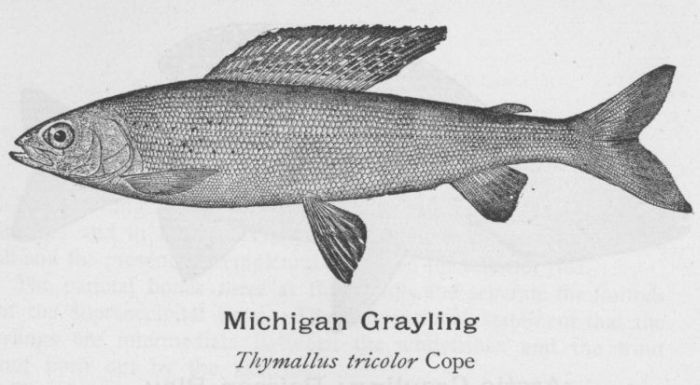
The Michigan grayling is known from various streams in the southern peninsula of Michigan and from Otter Creek, near Keweenaw, in the northern peninsula. It was formerly very abundant in the Au Sable and Jordan rivers, and other streams of northern Michigan, but through the destructive and wholly inexcusable methods by which the lumbering and logging operations have been carried on in that region these streams have been ruined and the grayling practically exterminated.
The Michigan grayling began to receive the attention of naturalists, fish-culturists, and anglers about 25 years ago, but no great success was ever attained in its artificial propagation. With anglers it has been held in very high esteem.
"There is no species sought for by anglers that surpasses the grayling in beauty. They are more elegantly formed and more graceful than the trout, and their great dorsal fin is a superb mark of loveliness. When the well-lids were lifted, and the sun's rays admitted, lighting up the delicate olive-brown tints of the back and sides, the bluish-white of the abdomen, and the mingling of tints of rose, pale blue, and purplish-pink on the fins, they displayed a combination of colours equaled by no fish outside the tropics." Mr. Fred. Mather describes the colouring of the grayling as follows: "His pectorals are olive-brown, with a bluish tint at the end; the ventrals are striped with alternate streaks of brown and pink; the anal is plain brown; the caudal is very forked and plain, while the crowning glory is the immense dorsal, which is dotted with large, brilliant-red or bluish purple spots, surrounded with a splendid emerald green, which fades after death--the changeable shade of green seen in the peacock's tail."
Head about 5; scales 93 to 98; D. 21 or 22, lower and smaller than in T. signifer. Colour, brilliant, purplish-gray; young more silvery; sides of head with bright bluish and bronze reflections; anterior part of side with small, irregular, inky-black spots; ventral fins ornate, dusky, with diagonal rose-coloured lines; dorsal with a black line along its base, then a rose-coloured one, then a blackish one, then rose-coloured blackish, and rose coloured, the last stripe continued as a row of spots; above these is a row of dusky-green spots, then a row of minute rose-coloured spots, then a broad dusky area, the middle part of the fin tipped with rose; anal and adipose fins dusky; central rays of caudal pink, the outer rays dusky.