Home › Volumes › Fishes › The Porgies
Jolt-head Porgy
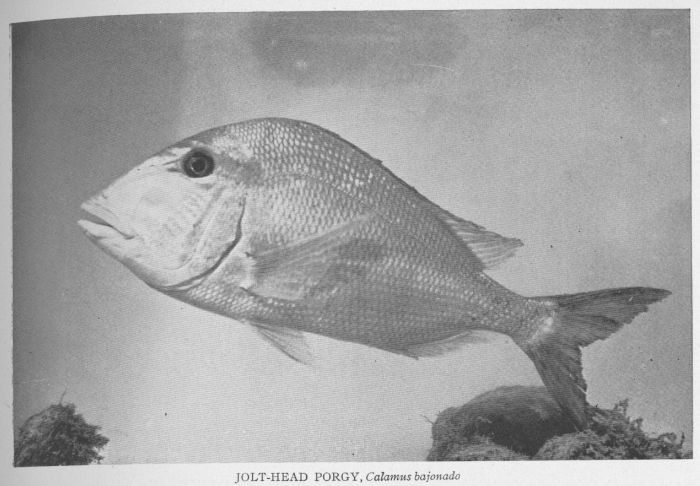
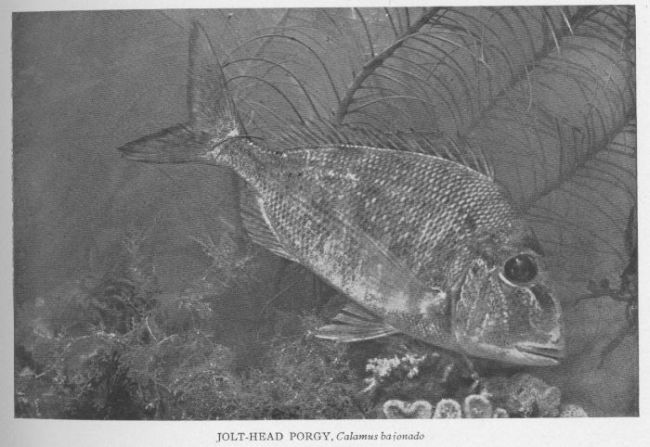
This, the most abundant species of the genus, is found among the Florida Keys and West Indies. It is also the largest species, reaching a length of 2 feet and a weight of 8 to 10 pounds. It frequents smooth rock bottom, upon which it is said to spawn in July and August. About Porto Rico it is one of the most common species, and is found at all times. Because of its large size the bajonado is more important as a food-fish than any of its congeners, though its flesh is rather coarse. It is taken in the hook-and-line fishery and also in various fish-traps.
Colour in life, rather dull brassy, with little blue markings; the middle of each scale shining but scarcely bluish; a blue stripe below eye, narrower and duller than in other species; a second duller streak above this, the 2 meeting on the forehead; preorbital dull coppery, often with irregular and obscure blue lines; axil yellowish.
The white-boned porgy (Calamus leucosteus) is a rather deep-water species known only from off the Carolina coast. Colour, smutty silvery; side with vague cross-bars; dorsal and anal with dark blotches; ventrals dusky. In from this species resembles C. penna.
The little-mouth porgy or sheepshead porgy (C. penna) occurs from southern Florida to Brazil. It is fairly abundant and widely distributed.
The grass or shad porgy (C. arctifrons) is a small species, rather common in shallow water among grass-patches at Key West and as far north as Pensacola. Colour, olivaceous, with dark bars or spots, the centres of many scales pearly; 6 yellowish spots along the lateral line; preorbital brownish, usually with dashes of golden yellow; membrane of opercle orange; fins mostly barred or spotted; ventrals pale, faintly barred. Though one of the smallest species of the genus, rarely exceeding a foot in length, it is nevertheless a good and important food-fish wherever found in sufficient numbers. It will take the hook, but it is usually taken in haul-seines.
GENUS LAGODON HOLBROOK
This differs from related genera chiefly in the form of the skull and the notched incisors; otherwise essentially as in Archosargus.
The single species is Lagodon rhomboides, the sailor's-choice, chopa spina, pigfish, or bream, a small species reaching a length of 6 inches, very abundant on our east coast from Cape Cod to Cuba and Texas. Though small, it is a most excellent pan-fish, and is highly prized wherever found.
Colour in life, olivaceous, the sides bluish silvery; a humeral spot and traces of 6 vertical bars; gilt stripes much less intense than in Archosargus unimaculatus, much broader than the interspaces; about 7 stripes below the lateral line, those above more or less confluent; dorsal fin pale bluish with a submedian gilt band and a gilt edge; caudal yellow, faintly barred; anal bluish, with a median yellowish band.
GENUS ARCHOSARGUS GILL
The Sheepsheads
This genus, like Lagodon, Stenotomus, and Otrynter, which show the same character of the procumbent dorsal spine, is confined to American waters. There are 2 colour types in the genus, one group being made up of species with broad black cross-bars, the other of species with longitudinal golden streaks and inconspicuous cross-bars, resembling Lagodon.
a. Occipital crest rather thin, its honeycomb structure not exposed. Species with streaks of steel-blue and golden, the dark crossbars narrow, disappearing with age.....unimaculatus
aa. Occipital crest broad, its honeycomb structure plainly exposed at its upper margin. Species without blue or golden markings, but with about 7 broad black cross-bars..probatocephalus