Home › Volumes › Fishes › The Barracudas
Great Barracuda; Picuda
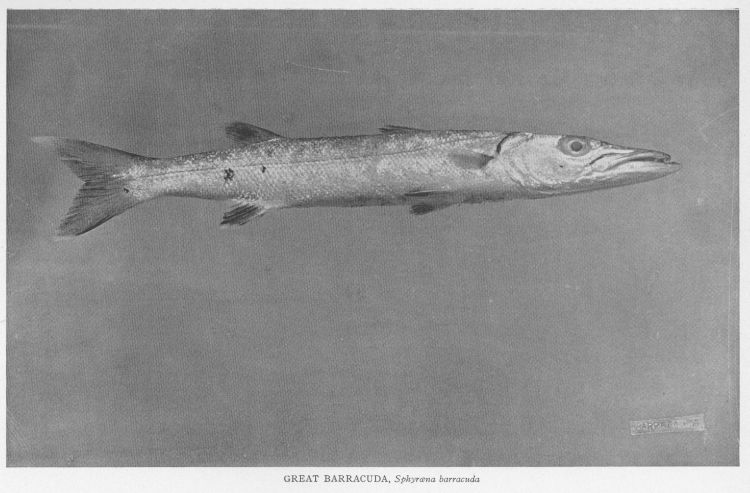
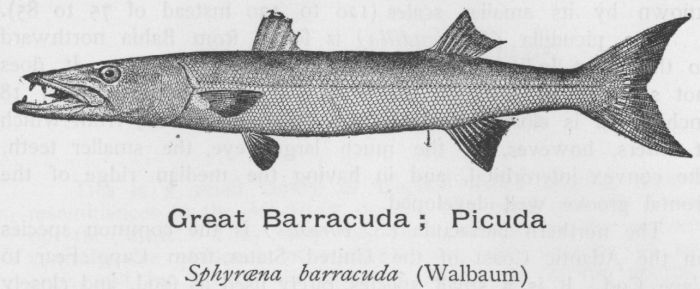
The great barracuda is found from Brazil northward through the West Indies to Pensacola, Charleston and the Bermudas. It is common in the tropics and is the largest and most voracious of the genus, reaching a length of 6 feet. It is as fierce as a shark and is sometimes very dangerous to bathers. This fish is occasionally taken with hook and line at Key West where it has some value as a food-fish. Its flesh has been reputed poisonous and at times its sale in the Cuban markets has been forbidden. But as a number of the best food-fishes of the West Indies have at one time or another been tabooed by Cuban law, this can not be regarded as conclusive evidence that the flesh of this fish is really unwholesome.
Colour, silvery, darker above; side in young with about 10 dark blotches which break up and disappear with age; some inky spots, usually on posterior part of body, very conspicuous in both old and young; soft dorsal, anal and ventral fins black, except on margins; pectoral plain, except upper margin which is black; fins of young nearly plain.
Another species, S. ensis, occurs in the Gulf of California and southward to Panama. It is rather common, reaches a length of 2 feet, and is used as food. It may be readily distinguished from the only other species known from the west coast (the California barracuda) by its larger scales, which are 110 to 130 in lateral line, instead of 166 in the latter.
A third species (S. guachancho), called guachanche or guachanche pelon, has about the same distribution as the great barracuda but is occasionally found as far north as Woods Hole. It is a slender species, reaching 2 feet in length, and is not uncommon in the tropics. From S. barracuda, it may be known by its smaller scales (120 to 130 instead of 75 to 85).
The picudilla (S. picudilla) is found from Bahia northward to the West Indies, chiefly about the coasts of Cuba. It does not seem to be common anywhere. It reaches a length of 18 inches and is closely allied to the northern barracuda, from which it differs, however, in the much larger eye, the smaller teeth, the convex interorbital, and in having the median ridge of the frontal groove well developed.
The northern barracuda (S. borealis) is the common species on the Atlantic Coast of the United States from Cape Fear to Cape Cod. It is a small species, rarely used as food, and closely resembles S. picudilla.
The California barracuda (S. argentea) occurs on our Pacific Coast from San Francisco to Cape San Lucas, very common among the Santa Barbara Islands. About Santa Catalina Island and San Diego it is one of the common and important gamefishes. It reaches a length of 4 or 5 feet. It is a long, slender fish, closely related to the European barracuda, from which it appears to differ chiefly in the somewhat greater depth and smaller scales.
Sphyraena sphyraena is the common species on the coasts of Europe and neighbouring islands. Within our limits it has been reported only from the Bermudas. It is known as spet or sennet.
Trolling for the great barracuda on the Florida coast is a favourite sport. It is done either from a sail-boat or row-boat, and a squit is a choice bait. Or, with boat anchored, they may be taken with tarpon rod and reel, 21 line, and wire snood 1 1/2 feet long. For bait use live mullet, spot, grunt, or other small fish. Do not use a sinker; keep the bait on or near the surface. When the fish bites, let him run a few feet and strike, then play him until he surrenders.