Home › Volumes › Fishes › The Snappers
Gray Snapper; Mangrove Snapper
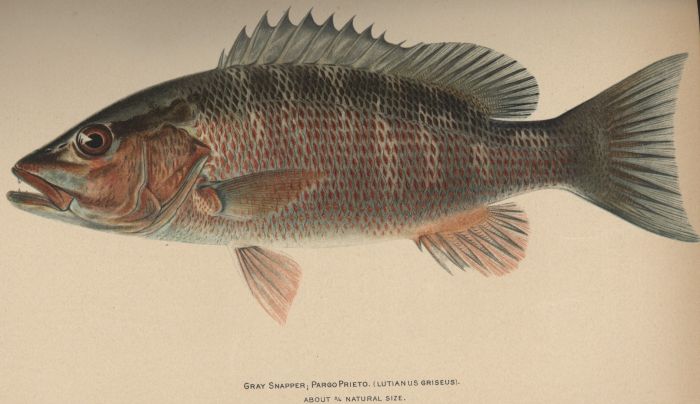
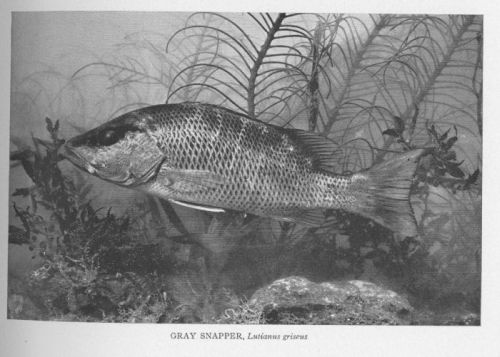
This is one of the most widely distributed, most abundant, and best known of all the snappers. It is found throughout the West Indies, is abundant on the Florida coast, and strays northward to New Jersey and Woods Hole. It is generally known as the gray snapper, but in Florida and the Bahamas, where the coasts are mangrove-lined, it is called the mangrove snapper; while in the West Indies among the Spanish-speaking people it is the cabellerote or pargo prieto. It inhabits waters of different depths, large examples often being found near the shore, while others equally large are often taken at considerable depths in company with the red snapper. Those from deep water are usually redder than shallow-water examples. In Indian River, Florida, the mangrove snapper is regarded as an excellent food-fish, and is an important commercial fish.
Its average weight there is about 2 pounds, and the maximum about 6 or 7 pounds. At Key West it is the most abundant of all the snappers, and attains a length of 3 feet and a weight of 18 pounds, though the average weight does not exceed 5 pounds. Here it is called gray snapper, and is regarded as a warm-water fish, being found in shallow water in summer, and retiring to deeper water in winter. It is said always to run in schools, and to spawn in July and August, usually on the shoals, the eggs being non-adhesive and separating readily from each other at spawning.
All the snappers are game-fishes of considerable importance, and the gray snapper is one of the very best. Its abundance and wide distribution, the ease with which it may be found at all seasons, together with the readiness and vigour with which it takes the hook and the fairly good fight which it makes, should cause this fish to be much sought after by the anglers who visit our Southern and tropical waters. One of the best places to find it of which we know is in Indian River, from Indian River Inlet southward. Another is in Jack Channel near Key West, where very large ones can be taken by using sardines and pilchards for bait.
Colour, very dark green above, middle part of each scale brassy black, the edge broadly pearly white; below lateral line the duskiness of middle of scale becomes brassy, and lower grayish; blue stripe below eye in very young; top of head blackish olive; dorsal fin bluish black; caudal violaceous or maroon-black, or bluish; anal rosy; pectoral pale flesh-colour. Fishes from deep water are much redder.