Home › Volumes › Fishes › The Flying-fishes
Flying-fishes
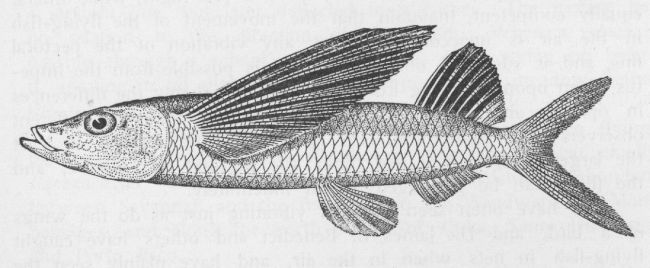
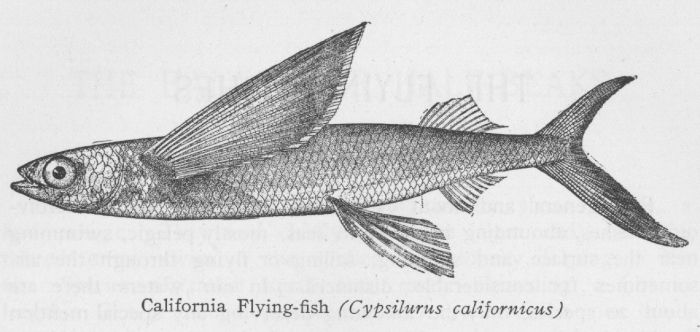
FIVE genera and about 65 species of carnivorous or herbivorous fishes, abounding in all warm seas, mostly pelagic, swimming near the surface, and skipping, sailing or flying through the air, sometimes for considerable distances. In our waters there are about 20 species, only the following deserving any special mention in this work.
The most common species off our Atlantic Coast is Parex-ocaetus mesogaster, which also occurs among the Hawaiian Islands. It reaches a length of 7 inches. The sharp-nosed flying-fish (Fodiator acutus), of which we present a figure, is found on both coasts of tropical America. It is common in the Gulf of California, and is a good food-fish.
The common flying-fish (Exocoetus volitans) inhabits all warm seas, on our coast north in summer to Newfoundland.
The California flying-fish (Cypsilurus californicus), of which we show a figure on next page, occurs from Point Conception to Cape San Lucas. It is very abundant in summer, and is found in great schools about the Santa Barbara Islands. This is the only flying-fish occurring on our Pacific Coast north of Cape San Lucas. It reaches a length of 18 inches, being the largest flying-fish known, and having the greatest power of flight. Where it goes in winter has not been determined, as it has not been seen out side of Californian waters. It is an excellent food-fish, and is sometimes taken by thousands off Santa Barbara.
Whether flying-fishes really fly, or merely soar or sail, is a question which has been much discussed. Competent observers have asserted positively that they have a real flight, while others, equally competent, maintain that the movement of the flying-fish in the air is unaccompanied by any vibration of the pectoral fins, and is sustained only so long as is possible from the impetus given upon emerging from the water. Probably the differences in opinion are largely explained by the fact that the different observers have studied different species. Some species, at least the larger ones, have a real flight; the pectoral fins vibrate, and the flight can be prolonged almost indefinitely.
We have often seen the fins vibrating just as do the wings of a bird, and Dr. James E. Benedict and others have caught flying-fish in nets when in the air, and have plainly seen the pectoral fins still vibrating.
Some of the smaller species seem to move quite differently, and it may be that they do not really fly.
The senior author of this work dissents from this common view expressed above, and does not believe that the pectoral fins have any large power of motion of their own, but that they quiver or vibrate only when the muscles of the tail are in action. He has, with Dr. Charles H. Gilbert, had, at Santa Rosa Island, California, the best possible opportunity to observe the motion of Cypsilurus californicus.