Home › Volumes › Fishes › The Whitefish, Salmon and Trout
Dolly Varden Trout
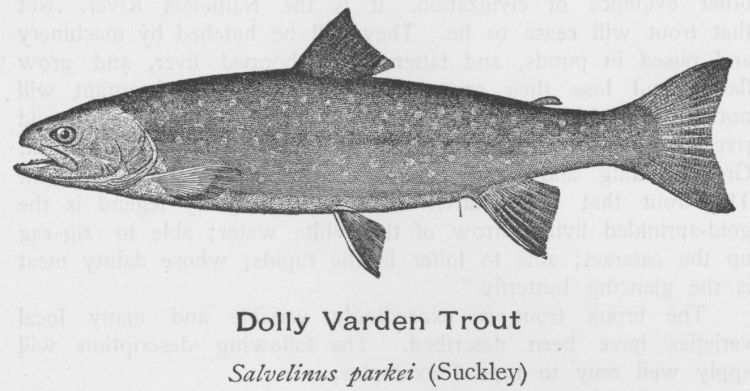
This interesting charr is found in the streams and lakes of Montana, Idaho, Washington, Oregon and California, south to the Sacramento basin, and northward in coastal streams to the Aleutian Islands. It is found only in Pacific drainage. Though resident in fresh water, and scarcely at all migratory, it often descends to the sea, and is frequently taken in salt and brackish waters. In small mountain brooks at Unalaska and elsewhere dwarfed forms occur.
This is the charr which has been known in the books until recently as Salvelinus malma, under the belief that it was identical with the malma of Walbaum from Kamchatka; but recent investigations have shown the American fish to be distinct from the Kamchatkan species.
In Montana this charr is called salmon trout, in Idaho it is the bull trout, and elsewhere it is charr, western charr, Oregon charr, or Dolly Varden trout, the last being one of the few book names of fishes which have come into general use.
This interesting trout is one of the best known species in the West. It reaches a length of 2 to 3 feet, and a weight of 5 to 12 pounds. An example 26 inches long weighed 5 pounds and 1 ounce. Like its eastern relative it is a voracious fish, feeding freely upon whatever offers, and especially fond of minnows, of which it devours great numbers. At Lake Pend d'Oreille, where the bull trout is an abundant and popular game-fish, we have found 2 species of minnows and one miller's thumb all in the stomach of one fish.
It has been our pleasure to fish for the Dolly Varden trout in many different waters, among which we recall with particular satisfaction the Pend d'Oreille River from the Great Northern Railroad to the international boundary, Lake Pend d'Oreille at Hope and Sand Point, the Redfish Lakes and Upper Salmon River, high among the Sawtooth Mountains of Idaho, and in a little stream near Unalaska, in which dwells a dwarfed Dolly Varden of unusual beauty. During July and August, as well as in early spring, it may be caught in any of these waters. In the smaller lakes it is most abundant about the mouths of the inlets, but the best fishing is usually in the streams, as the fish there will rise to the fly more readily, and are usually more gamy. Anything will serve as a lure--artificial fly, grasshopper or any other insect of fair size, small minnow, a piece of fish or other meat, salmon eggs, trolling spoon or frog, and even the bright coloured leaves of the painted cup or other flower.
The gameness of the Dolly Varden trout varies greatly with the character of the water and the season, just as with any other game-fish. Those taken in lakes are apt to be sluggish, but when taken in cold streams, with a good, strong, steady current, or in the rapids where the water tumbles and boils, then the Dolly Varden displays the superior game qualities which show its kinship with its eastern and better known congener.
Head 3 1/2 to 3 4/5; depth 4 4/5 to 6; eye 6 1/2 to 7; snout 3 to 4; maxillary 1 2/3 to 3; D. 11.; A. 9; scales 39-240-36; pyloric coeca large, 45 to 50; gillrakers about 8+12. Body rather slender, the back somewhat elevated, less compressed than in Salvelinus fontinalis; head large, snout broad, flattened above; mouth large, the maxillary reaching past the eye; fins short, the caudal slightly forked or almost truncate. General colour, olivaceous, the sides with round red or orange spots nearly as large as the eye, the back with similar but smaller spots, and without reticulations, a feature of colouration which at once distinguishes this from all other American trout; lower fins coloured much as in S. fontinalis, dusky, with a pale stripe in front, followed by a darker one. Sea-run examples are silvery, with the spots pale or obsolete.