Home › Volumes › Fishes › The Cutlass Fishes
Cutlass Fishes
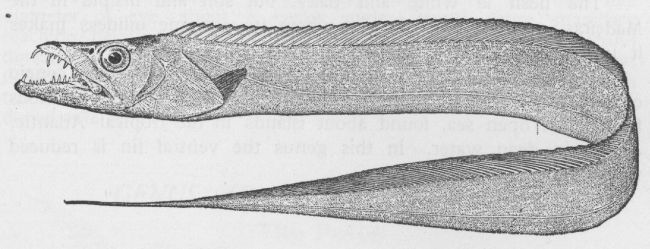
BODY extremely elongate, band-shaped, naked, tapering to a point, the ventral fins imperfect or wanting and the spinous and soft parts of the dorsal fin not differentiated. Mouth wide, the jaws armed with strong unequal teeth. Premaxillaries not protractile. Pseudobranchiae present. Gills 4, a slit behind the fourth; gill-membranes separate, free from the isthmus; lateral line present; dorsal fin very long, low, usually continuous, the rays all similar; caudal fin absent; anal fin very long and low, scarcely rising above the surface of the skin; ventrals thoracic, rudimentary (Eupleurogrammus) or wanting; vertebrae in greatly increased number, about 160; air-bladder present; pyloric coeca numerous. Genera 2, species about 6.
The single species in our waters in Trichiurus lepturus, known as the cutlass-fish, scabbard-fish, silver-fish, machete, sable, or savola, a long, slender, ribbon-like fish found in the West Indies and north to Virginia. It occurs also on the Pacific Coast about Lower California. It is taken occasionally in the lower Chesapeake and along the South Atlantic Coast. It is not common at Key West and its capture usually excites much interest. In Porto Rico, where it is known by the very appropriate name, machete, it is not rare.
Though not abundant enough to be of commercial importance, it is nevertheless an excellent food-fish.