Home › Volumes › Fishes › The Whitefish, Salmon and Trout
Cut-throat Trout
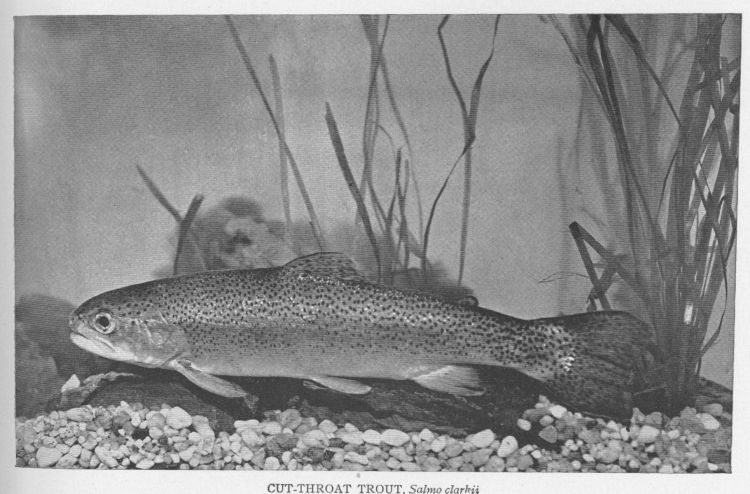
The cut-throat trout, probably the parent form from which all others of the series have been derived, is found in all the coastwise streams and lakes from northern California to British Columbia and possibly into southeastern Alaska. In the Columbia River basin it is found as far up the Snake River as Shoshone Falls and into the headwaters of the Pend d' Oreille. In the waters about Puget Sound it is very abundant, as it is, in fact, throughout most of its range.
It is known variously as cut-throat trout, black-spotted trout, Columbia River trout, and by many other local names.
In the earlier books this species was identified with the Mykiss of Kamchatka and was called Salmo mykiss or Salmo purpuratus. But recent investigations have shown that it is not identical with the Kamchatkan species, and that there is a wide region between Kamchatka and southeast Alaska in which no trout are found.
The cut-throat trout and all of this series spawn in the spring and early summer. Those in the streams seek the shallow waters of the smaller creeks while those of the lakes come to the shallow waters near shore or upon the bars; in many cases they ascend tributary streams.
The silver trout of Lake Tahoe and the yellow-finned trout of Twin Lakes probably spawn in deeper water.
The cut-throat trout and its different derived forms vary greatly in the sizes at which they reach maturity, the chief factors being, of course, the size of the body of water they inhabit and the amount of the food supply.
Those species or individuals, dwelling in lakes of considerable size where the water is of such temperature and depth as insure an ample food-supply, will reach a large size, while those in a restricted environment where both the water and food are limited, will be small directly in proportion to these environing restrictions. The trout of the Klamath Lakes, for example, reach a weight of at least 17 pounds, while in Fish Lake in Idaho mature trout do not exceed 8 to 9 1/4 inches in total length or one-fourth pound in weight. In small creeks in the Sawtooth Mountains and elsewhere they reach maturity at a length of 5 or 6 inches, and are often spoken of as brook trout under the impression that they are a species different from the larger ones found in the lakes and larger streams. But as all sorts of gradations between these extreme forms may be found in the intervening and connecting waters the differences have not even subspecific significance.
The various forms of cut-throat trout vary greatly in game qualities; even the same species in different waters, in different parts of its habitat, or at different seasons, will vary greatly in this regard. In general, however, it is perhaps a fair statement to say that the cut-throat trout are regarded by anglers as being inferior in gaminess to the eastern brook trout. But while this is true, it must not by any means be inferred that it is without game qualities, for it is really a fish which possesses those qualities in a very high degree. Its vigour and voraciousness are determined largely, of course, by the character of the stream or lake in which it lives. The individuals which dwell in cold streams about cascades and seething rapids will show marvellous strength and will make a fight which is rarely equalled by its eastern cousin; while in warmer and larger streams and lakes they may be very sluggish and show but little fight. Yet this is by no means always true. In the Klamath Lakes where the trout grow very large and where they are often very loggy, one is occasionally hooked which tries to the utmost the skill of the angler to prevent his tackle from being smashed and at the same time save the fish. An instance is on record of a most enthusiastic and skilful angler who required one hour and three-quarters to bring to net a nine and three-quarter pound fish in Pelican Bay, Upper Klamath Lake.
These trout can be taken in all sorts of ways. Trolling in the lakes with the spoon or phantom minnow is the usual method, but they rise readily to the artificial fly, the grasshopper, or a bunch of salmon eggs. In the larger streams they may be caught in any of these ways, while in the smaller streams casting with the fly or with hook baited with grasshopper or salmon eggs is the most successful way.
To enumerate the streams and lakes in the West where one may find good trout-fishing would be entirely impracticable; they are numerous in all the Western States. One of us has found exceptionally fine trout fishing at the Dempsey Lakes in Montana, in and about the Payette and Redfish lakes in Idaho, in Pacific Creek, and in the Klamath Lakes. Near Redfish Lake, in Idaho, is a small lake known as Fish Lake. Its area is about 25 acres. It is nearly circular in form, very shallow, and 9000 feet above sea-level. In this little lake a particularly beautiful form of cut-throat is exceedingly abundant.