Home › Volumes › Fishes › The Porgies
Common Sheepshead
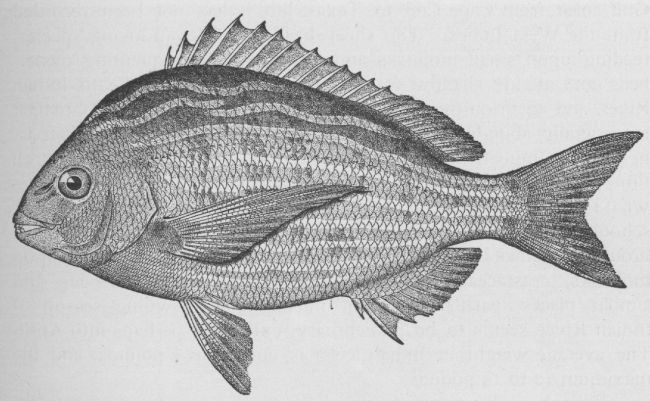
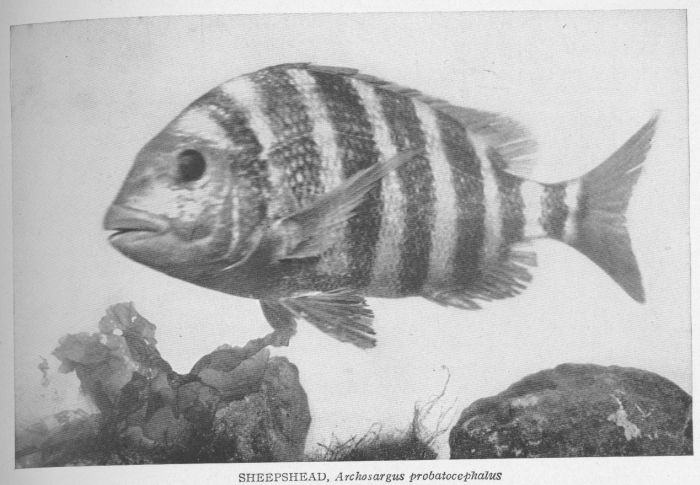
The sheepshead is one of our commonest and best-known fish, its range extending throughout the entire length of our Atlantic and Gulf coast from Cape Cod to Texas, but it has not been recorded from the West Indies. The sheepshead is a bottom-loving species, feeding upon small mollusks and other animals frequenting oysterbeds and muddy shallow waters. From the Chesapeake to Indian River, and again on the Gulf coast from Tampa to Corpus Christi, it is generally abundant in all suitable places. In Indian River it is, next to the mullet, the most abundant food-fish, and is found at all times. Though playing in and out with the tide, and moving somewhat from place to place, it is not properly a migratory fish. It does not school, as the mullets do, but is often found in considerable bunches, brought together by presence of food. Feeding almost wholly upon mollusks, crustaceans, and plants, it frequents oyster-beds and similar places, particularly about inlets. The spawning season in Indian River seems to be in February, extending perhaps into April. The average weight in Indian River is only 3 or 4 pounds, and the maximum 12 to 15 pounds.
Though a salt-water fish, the sheepshead often runs far up freshwater rivers, particularly the St. Johns in Florida. Throughout its entire range it is regarded as one of the very best food-fishes and is of great commercial importance. There is no more common or better-known fish in the markets of our Atlantic seaboard cities and towns.
As a game-fish the sheepshead is one of the most popular among our salt-water species, and there are many noted places between New York and Biscayne Bay where anglers resort for its capture. As long ago as 1814 Samuel Latham Mitchill, the naturalist-senator of New York, wrote in highest praise of the pleasures of angling for sheepshead: "When a sheepshead is brought on board more joy is manifested than by the possession of any other kind of fish. The sportsmen view the exercises so much above common fishing that the capture of the sheepshead is the most desirable combination of luck and skill; and the feats of hooking and landing him safely in the boat furnish abundant materials for the most pleasing and hyperbolical stories. The sheepshead is a very stout fish, and the hooks and lines are strong in proportion; yet he frequently breaks them and makes his escape."
And good old Thaddeus Norris says: "In fishing with a handline, which is the usual mode of taking him, the sheepshead gives one or two slight premonitory jerks, and then a steady pull, when the fisherman gathers in his line as fast as possible, the fish coming along with a heavy drag. When he approaches the boat, there is a desperate contest; there is much probability of his breaking the hook, or his quick downward lunges are apt to snap the line; then the fisher takes in slack or lets the line run through his fingers, as the actions of the fish dictate, and when a proper opportunity offers, throws him into the boat. His pull is at first strong and steady, but as he comes to the surface, his lunges are quick and desperate."
Our personal experience with the sheepshead has been chiefly at Indian River Inlet, one of Senator Quay's favourite fishing-grounds, and about Baldwin Lodge, Mississippi, where the Hon. A. Baldwin and other enthusiastic anglers of New Orleans find royal sport with this and other gamy species.
So well known is the sheepshead that it needs no detailed description.
GENUS DIPLODUS RAFINESQUE
This genus is close to Archosargus, from which it differs chiefly in having no procumbent dorsal spine. There are 3 species in our waters, the only one of any importance being the pinfish or spot, Diplodus holbrooki. This fish is found on our South Atlantic and Gulf coasts from Cape Hatteras to Cedar Keys. At Beaufort, North Carolina, it is not uncommon, and the young swarm about the wharves. It is frequent also at Lake Worth, where it is called jimmy. It reaches 8 inches in length and is an excellent pan-fish.