Home › Volumes › Fishes › The Porgies
Common Scup; Scuppaug
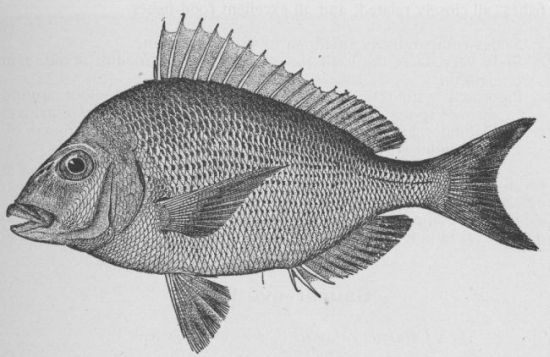
This fish is found on our Atlantic coast from the Carolinas to Cape Cod, being especially abundant northward. On the New England coast it is usually called scup, while about New York it is the paugy or porgy. Farther south it is the fair-maid, and at Charleston it is the porgy. In New England it is often called scuppaug, a corruption of the Narragansett Indian name mishcuppanog, and an excellent name it is. Though somewhat erratic in its appearance, it is usually quite abundant on our Northern coast. As a food-fish it is one of the commonest and most esteemed. It is a bottom feeder, depending largely upon mollusks of various kinds and worms and small crustaceans.
Colour, brownish, somewhat silvery below, everywhere with bright reflections, but without distinct markings in adult; soft parts of vertical fins mottled with dark in adult; young faintly barred; axil dusky.
The Southern porgy, Stenotomus aculeatus, is found from Cape Hatteras southward and on the Gulf coast to Texas. It closely resembles the Northern scup, which it replaces southward.
GENUS CALAMUS SWAINSON
The Porgies
This genus contains some 12 species, all American, all shore-fishes, all closely related, and all excellent food-fishes.
a. Scales comparatively small, 54 to 58 in lateral line.
b. Body very deep, the back elevated, the depth in adult about 2 in length.
c. Preorbital with reticulations of the bluish ground colour around bronze spots.....calamus
cc. Preorbital region, snout, cheek, and opercles brassy, crossed by horizontal wavy, non-reticulating lines of violet-blue. proridens
bb. Body more elongate, the depth 2 1/6 to 2 3/4 in length.bajonado
aa. Scales comparatively large, 45 to 53 in lateral line.
d. Dorsal outline forming a comparatively regular arch.....penna
dd. Dorsal outline not forming a regular arch.....arctifrons