Home › Volumes › Fishes › The Codfishes
Common Codfish
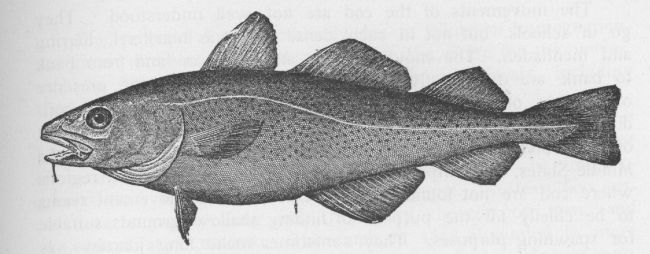
This important and well-known fish is found in the North Atlantic and on both coasts, south to France and Virginia. From the earliest settlement of America the cod has been the most valuable of our Atlantic Coast fishes. Indeed, the codfish of the Banks of Newfoundland was one of the principal inducements which led England to establish colonies in America, and in the records of early voyages are many references to the abundance of codfish along our shores. It is even claimed that English vessels visited the fishing grounds near Iceland as early as 1415, and that the Basques knew the Banks of Newfoundland centuries before the discovery of America by Columbus. So important was the cod in the early history of this country that it was placed upon the colonial seal of Massachusetts, and it was also placed upon a Nova Scotian bank-note, with the legend "Success to the Fisheries."
The cod is omnivorous, and feeds upon various kinds of animals, including crustaceans, mollusks and small fishes, and even browses upon Irish moss and other aquatic vegetation. All sorts of things have been found in cods' stomachs, such as scissors, oil-cans, finger-rings, rocks, potato parings, corn cobs, rubber dolls, pieces of clothing, the heel of a boot, as well as many new or rare specimens of mollusks and crustaceans. The belief that the stones are taken in by the cod as ballast, and that the finger-rings, boot-heels, etc., indicate that the cod is a "man-eater," are by no means necessary conclusions.
The movements of the cod are not well understood. They go in schools, but not in such dense bodies as mackerel, herring and menhaden. The movements on and off shore and from bank to bank are due chiefly to temperature influences, the presence or absence of food, and the search for proper spawning conditions. In the winter months there is a well-marked movement of large bodies of cod to the shores of New England and the Middle States, and important fisheries are then carried in regions where cod are not found at other seasons. This movement seems to be chiefly for the purpose of finding shallow grounds suitable for spawning purposes. They sometimes make long journeys, as is evidenced by the capture on the New England Coast of cod with hooks in their mouths such as French fishermen use on the Grand Banks. The cod is essentially a deep-water fish, and is usually taken in 20 to 70 fathoms. It has been taken at 300 fathoms depth.
The largest cod recorded from New England weighed 211 1/2 pounds and was over 6 feet long. It was taken on a trawl off the northern coast of Massachusetts in May, 1895. Many examples weighing 100 to 175 pounds have been recorded, but cod weighing even 75 pounds are not at all common. The average weight of the large-size cod caught in the shore-waters of New England is about 35 pounds; on Georges Bank, 25 pounds; on the Grand Bank and other eastern grounds, 20 pounds. The average weight of the small-size cod caught on all these grounds is about 12 pounds.
The principal spawning time of the cod on the New England coast is in the winter, the season beginning as early as November, and continuing until April.
The cod is one of the most prolific fishes. The ovaries of a 21-pound cod have been computed to contain 2,700,000 eggs, and a 75-pound cod, 9,100,000 eggs. The egg is very small, only about 1/19 to 1/17 of an inch in diameter, and about 337,000 are required to make one quart. When it is remembered that under natural conditions, in order to maintain the normal number of codfish it is only necessary for two of these eggs to hatch and grow to maturity, it is easily seen that the destruction of eggs is very great. If all the eggs of a 75-pound cod should hatch and grow to maturity, the ocean would soon become packed solid with codfish.
The principal loss is probably due to failure of impregnation, to great numbers being thrown upon the shore by the waves, and to the vast numbers eaten by various animals, including fishes, birds and invertebrates.
Commercially the cod is most important. In the matter of persons engaged, vessels employed, capital invested and value of catch, the taking of codfish in the United States is more extensive than any other fishery for fish proper. At least 600 vessels are engaged taking cod; they carry about 7,000 men, and are valued at $3,000,000. The catch in 1898 amounted to more than 96,000,000 pounds, with a first value of about $2,000,000.
Cod are taken with hand and trawl lines, baited with fish, squid, etc., and fished for from small boats, or the vessel's deck. The principal grounds are the "banks"--Grand, Georges, Western, Quereau, etc.
The cod is propagated artificially on a more extensive scale than any other marine fish. The number of cod fry liberated by the United States Fish Commission up to 1898 was 449,764,000. The output for 1896-97 was 98,000,000, and the unmistakable economic results which have attended these efforts warrant all the time and money devoted to them, and justify the greatest possible expansion of the work.
The common cod is greenish or brownish, subject to great variations, sometimes yellowish or reddish, the back and sides with numerous rounded brownish spots; lateral line pale; fins dark.