Home › Volumes › Fishes › The Whitefish, Salmon and Trout
Brook Trout; Speckled Trout
"And when the timorous Trout I wait
To take, and he devours my Bait,
How small, how poor a thing I find
Will captivate a greedy Mind;
And when none bite, the Wise I praise,
Whom false Allurement ne'er betrays."
The game-fish which has been most written about and which is, perhaps, best and most widely known among the anglers of the world is undoubtedly Salvelinus fontinalis. It is one of the most beautiful, active, and widely distributed of American trouts. Its natural range is from Maine to northern Georgia and Alabama in the Appalachian Mountains, and westward through the Great Lakes region to Minnesota; and in Canada from Labrador to the Saskatchewan. It has been extensively introduced into many waters in which it was not native, in the eastern and upper Mississippi Valley States, in the Pacific and Rocky Mountain States, and in many foreign countries as well.
With the possible exceptions of the rainbow and steelhead trouts it is the hardiest member of the salmon family and will make a brave struggle for existence even in an unfavourable environment. Not every stream, however, can be stocked with this species; the temperature of the water must not be too high, nor the flow too sluggish, although a high temperature is not wholly prohibitive, if there is a strong current resulting in the proper aeration of the water. The best streams are those with a gravelly bottom, clear shallow water, steady, fairly strong current with occasional rapids, deeper pools and eddies, abundant natural food, and banks overhung with bushes which afford more or less protection.
The brook trout spawns in the fall when the water is growing colder. The season extends from late August in the Lake Superior region to October and November or even later in New England, New York and southward. At spawning time the fish will push far up even the smallest creeks where the spawning beds are selected upon gravel bottom in shallow water. There the eggs will lie until the next spring--anywhere from 90 to 210 days--when the water begins to grow warmer and the eggs begin to hatch.
The number of eggs produced varies with the age and size of the fish, yearlings usually producing 150 to 250, two-year-olds 350 to 500, and older ones 500 to 2500.
The size of the brook trout varies greatly; in small streams they may be mature at a length of 6 or 8 inches and a weight of but 2 or 3 ounces, while in larger bodies of water and with an abundant food supply they reach 18 inches or even more, and a weight of several pounds. Forty years ago brook trout weighing 4 to 6 and 8 pounds were not uncommon.
But as the trout streams everywhere came to be fished more and more, the trout became smaller and smaller, until now it is a rare trout that escapes the angler's fly until he has reached a greater weight than a pound or two.
The trout are rapidly disappearing from our streams through the agency of the lumberman, manufacturer, and summer boarder. In the words of the late Rev. Myron W. Reed, a noble man, and an excellent angler,--"This is the last generation of troutfishers. The children will not be able to find any. Already there are well-trodden paths by every stream in Maine, New York, and in Michigan. I know of but one river in North America by the side of which you will find no paper collar or other evidence of civilization. It is the Nameless River. Not that trout will cease to be. They will be hatched by machinery and raised in ponds, and fattened on chopped liver, and grow flabby and lose their spots. The trout of the restaurant will not cease to be; but he is no more like the trout of the wild river than the fat and songless reed-bird is like the bobolink. Gross feeding and easy pond-life enervate and deprave him. The trout that the children will know only by legend is the gold-sprinkled living arrow of the white water; able to zig-zag up the cataract; able to loiter in the rapids; whose dainty meat is the glancing butterfly."
The brook trout is exceedingly variable and many local varieties have been described. The following description will apply well only to typical examples.
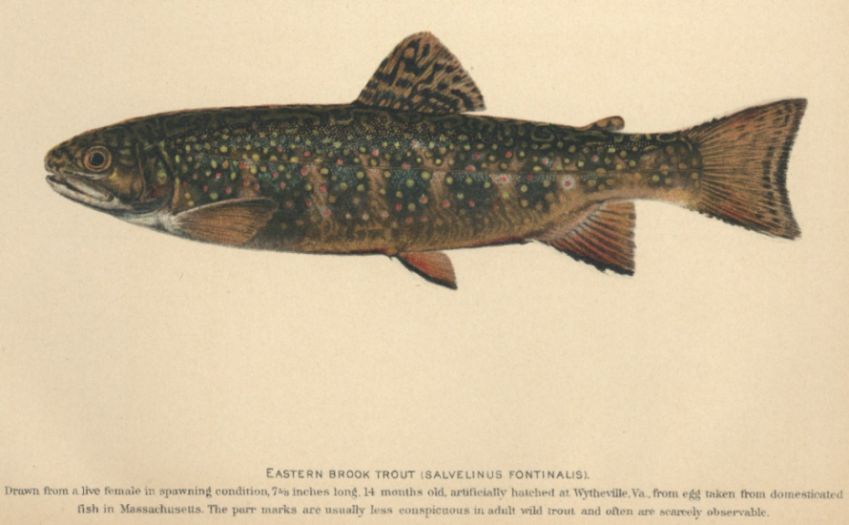
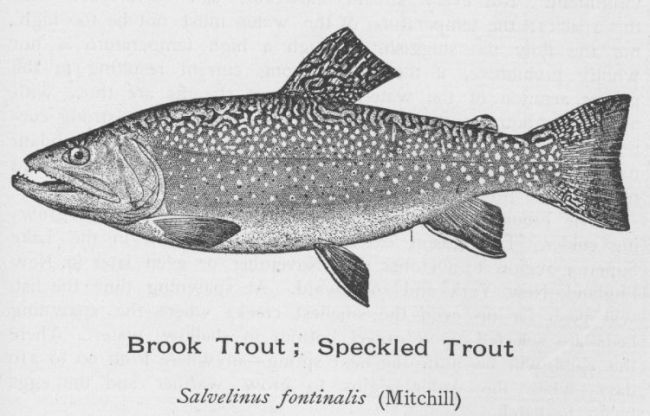
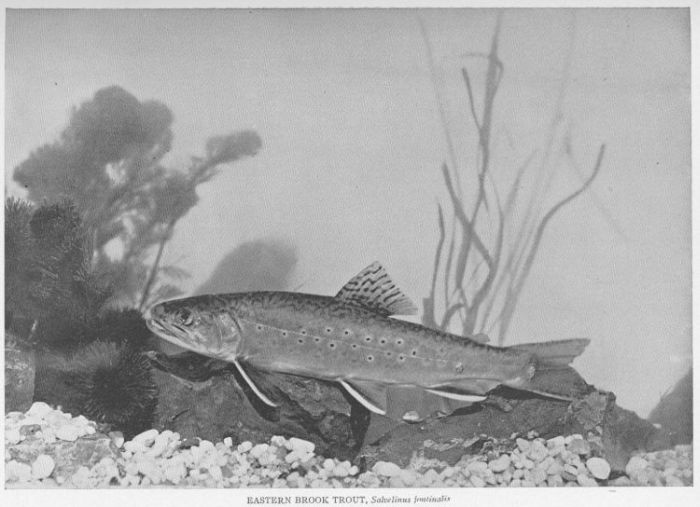
Head 4 1/2; depth 4 1/2; D. 10; A. 9; scales 37-230-30; gillrakers about 6+11. Body oblong, moderately compressed, not much elevated; head large, but not very long, the snout bluntish, the interorbital space rather broad; mouth large, the maxillary reaching beyond orbit; eye large, somewhat above axis of body; caudal fin slightly lunate in the adult, forked in the young; adipose fin small; pectoral and ventral fins not especially elongate. Colour, back more or less mottled or barred with dark olive or black, without spots; red spots on side rather smaller than the pupil; dorsal and caudal fins mottled with darker; lower fins dusky, with a pale, usually orange, band anteriorly, followed by a darker one; belly in the male often more or less red; searun individuals (the Canadian "salmon trout") are often nearly plain bright silvery.