Home › Volumes › Fishes › The Basses, Crappies and Sunfishes.
Bluegill
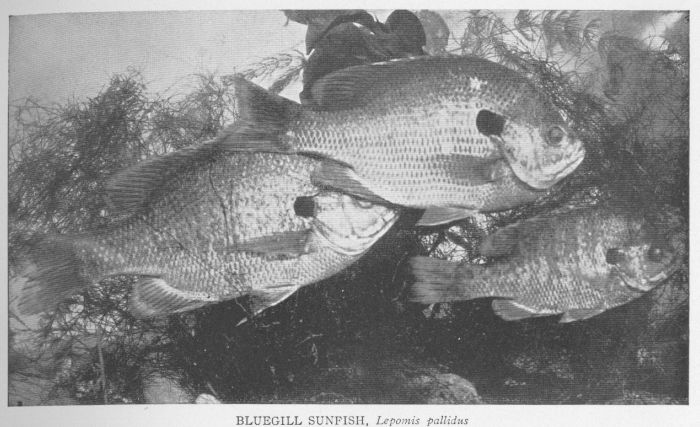
The bluegill is perhaps the best known and certainly the most important of all our true sunfishes. It is known also as blue bream, blue sunfish, copper-nosed sunfish, dollardee, and doubtless by many other vernacular names. It is found throughout the Great Lakes and in the Mississippi Valley, from western New York and Pennsylvania to Iowa and Missouri, and from Minnesota to Florida and the Rio Grande. It is one of our most variable and widely distributed species, and is found in all lakes, ponds and quiet streams throughout its range. Though found in quiet streams, it is, above all, the sunfish of the lakes, whether large or small, but is decidedly more abundant in the smaller ones. In the small glacial lakes of northern Indiana it is found in very great numbers.
The bluegill is the largest of the sunfishes. It reaches a length of 12 to 14 inches, and a weight of nearly a pound. The average weight of those taken at Lake Maxinkuckee is about half a pound, while those at Bass Lake (another famous bluegill lake 10 miles west from Lake Maxinkuckee) do not average more than 3 or 4 ounces. The maximum weight is about 1 1/2 pounds.
As a food-fish the bluegill is of much importance, and of all the species it is the one most often sent to market, where it always brings a good price. As a pan-fish it is excelled, among fresh-water fishes, only by the yellow perch. Its flesh is firm and flaky, and possesses a delicious flavour. And among all the sunfishes it holds the highest rank as a game-fish.
It can be taken at any time in the year, even through the ice in winter. It bites well during the spring and early summer, while from early July until September it is particularly voracious, and fine catches can then be made. It will take any sort of bait, and can be taken with any sort of tackle. Angleworms are probably the best bait, either in still-fishing or trolling, but grasshoppers are also excellent. White grubs, small minnows, small pieces of fish or mussel are good; and they can be taken on the artificial fly, or small trolling spoon.
Most of those who fish for bluegills do so at anchor and with two long cane poles projecting over either side of the stern of the boat. The line always has a float upon it, its distance from the hook regulated by the depth of the water, and the hook is thrown as far from the boat as possible.
The bluegills are usually found in 5 to 15 feet of water on the edges of the bars where there are patches of Potamogeton or other water plants. They usually keep in more or less definite schools, and the patient angler usually lands them all. They do not seize the hook with a rush as does the rock bass, but quietly suck it in, and the fight does not begin until the fish finds that it is hooked, but from then on the fight is of the most vigorous kind, and is kept up to the end with a persistency and viciousness that make the bluegill "the gamest of all fishes for its size."
Colour, rich greenish olive on back, becoming paler on sides; top of head dark greenish; opercles and cheek bluish; opercular flap rich velvety black, a small whitish spot above near its base; side with 3 or 4 broad darker greenish bars; fins all greenish, the pectoral palest, reddish at base; a large black blotch on last rays of dorsal, a similar one on anal; the dark bars become obsolete in the adult; no blue stripes on cheek; no red on fins; old individuals often with the belly coppery red or brassy.
GENUS EUPOMOTIS GILL & JORDAN
This genus is closely related to Lepomis, from which it differs only in the blunter and more pavement-like teeth of the lower pharyngeal bones. These bones are usually broader and more concave than in Lepomis, the gillrakers are usually shorter and fewer, the supplemental maxillary is reduced or wanting, and the opercular flap is always provided with an orange spot on its lower posterior border. The genus as now understood contains 6 known species.
a. Pectoral fin short, not longer than head, not reaching past origin of anal.
b. Mouth large, maxillary about reaching pupil; supplemental maxillary present; gillrakers hard and of moderate length.
c. Dorsal spines moderate, the longest equalling snout and 1/2 the orbit; depth 2 1/3; body with 8 or 9 dusky crossbars; pallidus
cc. Dorsal spines shorter, the longest equalling snout and less than 1/3 of the orbit; ........................euryorus
bb. Mouth smaller, maxillary scarcely reaching orbit; supplemental maxillary absent or reduced to a slight rudiment; gillrakers very short and soft.
d. Pectoral fin slender, nearly as long as head; ........holbrooki
dd. Pectoral fin obtuse, shorter than head; ...............gibbosus
aa. Pectoral fin long, slender and pointed, longer than head, reaching middle of anal.
e. Gillrakers long, their ends obtuse; 44 scales in lateral line; longimanus
ee. Gillrakers short, as in E. gibbosus, 39 scales in lateral line; heros
Eupomotis pallidus, which has received no distinctive common name, occurs in lowland streams from Georgia to Texas. It appears to be rare and only a few specimens are known. It reaches a length of 7 inches.