Home › Volumes › Fishes › The Whitefish, Salmon and Trout
Blackfin Whitefish
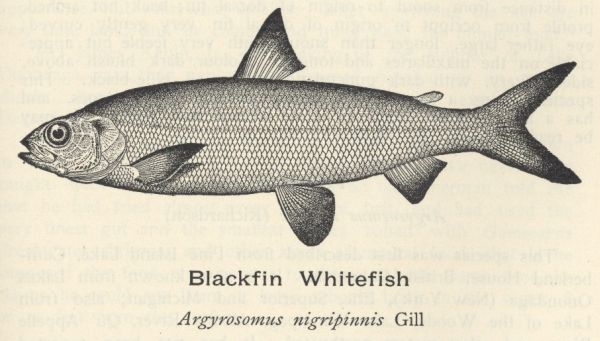
The blackfin whitefish is known certainly only from Lake Michigan and Miltona Lake, Minnesota, though it has been reported from other small deepwater lakes of Minnesota and Wisconsin. It has also been reported from Lake Superior, but all the specimens of so-called blackfin or bluefin that we have seen from that lake are the longjaw. The blackfin is probably the most abundant fish of commercial importance in the deeper waters of Lake Michigan. It occurs in schools, like other members of the group, and is associated with the lake trout and other deep-water species.
The spawning season is the same as that of the common whitefish--in November to December. Then the fish come out upon rocky bottom where the eggs are deposited. A favourite resort for blackfin is said to be the Mudhole, a large depression 20 miles east of Sheboygan, in which the depth is about 90 feet. The principal method by which the blackfin is taken is in the gillnets. It is regarded as a good food-fish. It reaches a length of 18 inches, and a weight of one to 2 pounds.
Head 4; depth 4; eye 4 1/2; D. 12; A. scales 9 or 10-73 to 77-7 or 8; vertebrae 57; gillrakers about 18+30, rather long and slender, 1 1/2 in eye or 2 in maxillary. Body stout, fusiform and compressed; head and mouth large; lower jaw slightly projecting; the maxillary 1/5 greater than eye and reaching vertical of front of pupil; distance from tip of snout to occiput about 3 1/3 in distance from snout to origin of dorsal fin; back not arched, profile from occiput to origin of dorsal fin very gently curved; eye rather large, longer than snout; teeth very feeble but appreciable on the maxillaries and tongue. Color, dark bluish above, sides silvery, with dark punctulations; fins all blue-black. This species attains a larger size than any of the other ciscoes, and has a larger mouth than any other except the bloater. It may be readily known by its black fins.