Home › Volumes › Fishes › The Smelts
American Smelt
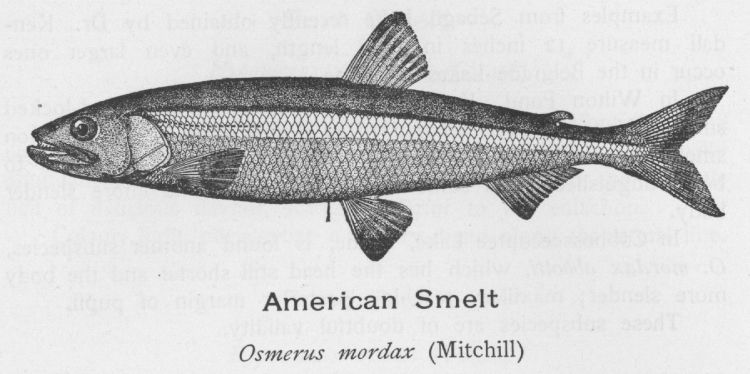
This is the smelt of America. It is found along our Atlantic Coast from Virginia to the Gulf of St. Lawrence, entering streams, and is often land-locked. It is abundant in Lakes Champlain and Memphremagog, and in many other lakes in New England, New Brunswick and Nova Scotia. It enters our rivers and brackish bays during the winter months for the purpose of spawning, when it is caught in immense numbers in nets and by hook and line. In 1622. Capt. John Smith wrote: "Of smelts there is such abundance that the Salvages doe take them up in the rivers with baskets, like sives"; and Josselyn, 55 years later, wrote: "The frostfish [O. mordax] is little bigger than a Gudgeon, and are taken in fresh brooks; when the waters are frozen they make a hole in the ice, about 1/2 yard or yard wide, to which the fish repair in great numbers, where, with small nets bound to a hoop about the bigness of a firkinhoop, with a staff fastened to it, they take them out of the hole." Great quantities are taken along the coast and usually after being frozen, are shipped to the larger cities. Those which have not been frozen are termed "green" smelts, and are much more highly esteemed.
The principal food of the smelt consists of shrimps and other small crustaceans.
Colour, transparent greenish above, sides silvery; body and fins with some dark punctulations. The smelt does not usually exceed 8 or 10 inches in length, but it sometimes exceeds a foot in length and a weight of a pound.
Examples from Sebago Lake recently obtained by Dr. Kendall measure 12 inches in total length, and even larger ones occur in the Belgrade Lakes of Maine.
In Wilton Pond, Kennebec County, Maine, is a land-locked smelt which has been recognized as a subspecies of the common smelt under the name Osmerus mordax spectrum. It seems to be distinguished by a somewhat shorter head and more slender body.
In Cobbosseecontee Lake, Maine, is found another subspecies, O. mordax abbotti, which has the head still shorter and the body more slender; maxillary reaching posterior margin of pupil.
These subspecies are of doubtful validity.