Home › Volumes › Bird Neighbours › Wood Warblers
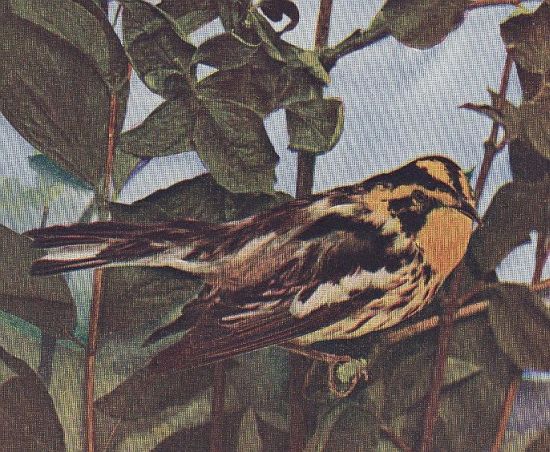
Blackburnian Warbler
Also called: HEMLOCK WARBLER; ORANGE-THROATED WARBLER; TORCH-BIRD
- Length
- 4.5 to 5.5 inches. An inch and a half smaller than the English sparrow.
- Male
- Head black, striped with orange-flame; throat and breast orange, shading through yellow to white underneath; wings, tail, and part of back black, with white markings.
- Female
- Olive-brown above, shading into yellow on breast, and paler under parts.
- Range
- Eastern North America to plains. Winters in tropics.
- Migrations
- May. September. Spring and autumn migrant.
"The orange-throated warbler would seem to be his right name, his characteristic cognomen," says John Burroughs, in ever-delightful "Wake Robin"; "but no, he is doomed to wear the name of some discoverer, perhaps the first who robbed his nest or rifled him of his mate--Blackburn; hence, Blackburnian warbler. The burn seems appropriate enough, for in these dark evergreens his throat and breast show like flame. He has a very fine warble, suggesting that of the redstart, but not especially musical."
No foliage is dense enough to hide, and no autumnal tint too brilliant to outshine this luminous little bird that in May, as it migrates northward to its nesting ground, darts in and out of the leafy shadows like a tongue of fire.
It is by far the most glorious of all the warblers--a sort of diminutive oriole. The quiet-colored little mate flits about after him, apparently lost in admiration of his fine feathers and the ease with which his thin tenor voice can end his lover's warble in a high Z.
Take a good look at this attractive couple, for in May they leave us to build a nest of bark and moss in the evergreens of Canada--that paradise for warblers--or of the Catskills and Adirondacks, and in autumn they hurry south to escape the first frosts.