Home › Volumes › Bird Neighbours › Wood Warblers
Black-and-white Creeping Warbler
Also called: VARIED CREEPING WARBLER; BLACK-AND-WHITE CREEPER; WHITEPOLL WARBLER
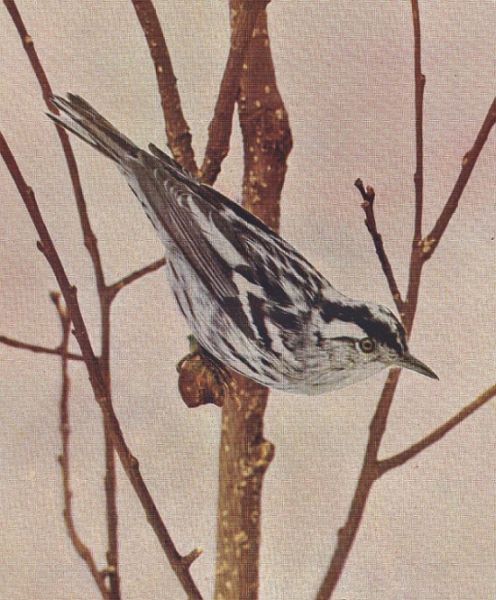
- Length
- 5 to 5.5 inches. About an inch smaller than the English sparrow.
- Male
- Upper parts white, varied with black. A white stripe along the summit of the head and back of the neck, edged with black. White line above and below the eye. Black cheeks and throat, grayish in females and young. Breast white in middle, with black stripes on sides. Wings and tail rusty black, with two white cross-bars on former, and soiled white markings on tail quills.
- Female
- Paler and less distinct markings throughout.
- Range
- Peculiar to America. Eastern United States and westward to the plains. North as far as the fur countries. Winters in tropics south of Florida.
- Migrations
- April. Late September. Summer resident.
Nine times out of ten this active little warbler is mistaken for the downy woodpecker, not because of his coloring alone, but also on account of their common habit of running up and down the trunks of trees and on the under side of branches, looking for insects, on which all the warblers subsist. But presently the true warbler characteristic of restless flitting about shows itself. A woodpecker would go over a tree with painstaking, systematic care, while the black-and-white warbler, no less intent upon securing its food, hurries off from tree to tree, wherever the most promising menu is offered.
Clinging to the mottled bark of the tree-trunk, which he so closely resembles, it would be difficult to find him were it not for these sudden flittings and the feeble song, "Weachy, weachy, weachy, 'twee, 'twee, 'tweet," he half lisps, half sings between his dashes after slugs. Very rarely indeed can his nest be found in an old stump or mossy bank, where bark, leaves, and hair make the downy cradle for his four or five tiny babies.
DUSKY AND GRAY AND SLATE-COLORED BIRDS
Chimney Swift
Kingbird
Wood Pewee
Phoebe and Say's Phoebe
Crested Flycatcher
Olive-sided Flycatcher
Least Flycatcher
Chickadee
Tufted Titmouse
Canada Jay
Catbird
Mocking-bird
Junco
White-breasted Nuthatch
Red-breasted Nuthatch
Loggerhead Shrike
Northern Shrike
Bohemian Waxwing
Bay-breasted Warbler
Chestnut-sided Warbler
Golden-winged Warbler
Myrtle Warbler
Parula Warbler
Black-throated Blue Warbler
See also the Grayish Green and the Grayish Brown Birds, particularly the Cedar Bird, several Swallows, the Acadian and the Yellow-bellied Flycatchers; Alice's and the Olive-backed Thrushes; the Louisiana Water Thrush; the Blue-gray Gnatcatcher; and the Seaside Sparrow. See also the females of the following birds: Pine Grosbeak; White-winged Red Crossbill; Purple Martin; and the Nashville, the Pine, and the Magnolia Warblers.
DUSKY, GRAY, AND SLATE-COLORED BIRDS