Home › Volumes › Bird Neighbours › Blackbirds, Orioles, Etc.
Baltimore Oriole
Also called: GOLDEN ORIOLE; FIREBIRD; GOLDEN ROBIN; HANG-NEST; ENGLISH ROBIN
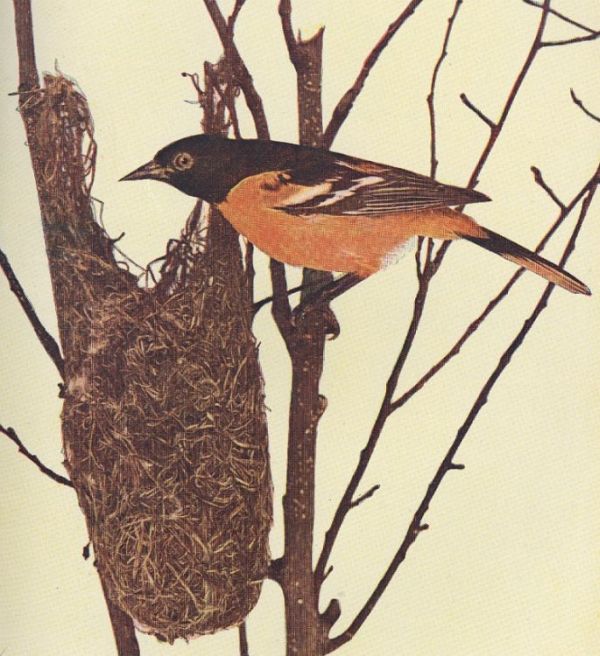
- Length
- 7 to 8 inches. About one-fifth smaller than the robin.
- Male
- Head, throat, upper part of back glossy black. Wings black, with white spots and edgings. Tail-quills black, with yellow markings on the tips. Everywhere else orange, shading into flame.
- Female
- Yellowish olive. Wings dark brown, and quills margined with white. Tail yellowish brown, with obscure, dusky bars.
- Range
- The whole United States. Most numerous in Eastern States below 55deg north latitude.
- Migrations
- Early may. Middle of September. Common summer resident.
A flash of fire through the air; a rich, high, whistled song floating in the wake of the feathered meteor: the Baltimore oriole cannot be mistaken. When the orchards are in blossom he arrives in full plumage and song, and awaits the coming of the female birds, that travel northward more leisurely in flocks. He is decidedly in evidence. No foliage is dense enough to hide his brilliancy; his temper, quite as fiery as his feathers, leads him into noisy quarrels, and his insistent song with its martial, interrogative notes becomes almost tiresome until he is happily mated and family cares check his enthusiasm.
Among the best architects in the world is his plain but energetic mate. Gracefully swung from a high branch of some tall tree, the nest is woven with exquisite skill into a long, flexible pouch that rain cannot penetrate, nor wind shake from its horsehair moorings. Bits of string, threads of silk, and sometimes yarn of the gayest colors, if laid about the shrubbery in the garden, will be quickly interwoven with the shreds of bark and milkweed stalks that the bird has found afield. The shape of the nest often differs, because in unsettled regions, where hawks abound, it is necessary to make it deeper than seven inches (the customary depth when it is built near the homes of men), and to partly close it at the top to conceal the sitting bird. From four to six whitish eggs, scrawled over with black-brown, are hatched by the mother oriole, and most jealously guarded by her now truly domesticated mate.
The number of grubs, worms, flies, caterpillars, and even cocoons, that go to satisfy the hunger of a family of orioles in a day, might indicate, if it could be computed, the great value these birds are about our homes, aside from the good cheer they bring.
There is a popular tradition about the naming of this gorgeous bird: When George Calvert, the first Lord Baltimore, worn out and discouraged by various hardships in his Newfoundland colony, decided to visit Virginia in 1628, he wrote that nothing in the Chesapeake country so impressed him as the myriads of birds in its woods. But the song and color of the oriole particularly cheered and delighted him, and orange and black became the heraldic colors of the first lords proprietors of Maryland.
Hush! 'tis he!
My Oriole, my glance of summer fire,
Is come at last; and ever on the watch,
Twitches the pack-thread I had lightly wound
About the bough to help his housekeeping.
Twitches and scouts by turns, blessing his luck,
Yet fearing me who laid it in his way.
Nor, more than wiser we in our affairs,
Divines the Providence that hides and helps.
Heave, ho! Heave, ho! he whistles as the twine
Slackens its hold; once more, now! and a flash
Lightens across the sunlight to the elm
Where his mate dangles at her cup of felt.
--James Russell Lowell.
BIRDS CONSPICUOUSLY RED OF ANY SHADE
Cardinal Grosbeak
Summer Tanager
Scarlet Tanager
Pine Grosbeak
American Crossbill and the White-winged Crossbill
Redpoll and Greater Redpoll
Purple Finch
Robin
Orchard Oriole
See the Red-winged Blackbird (Black). See also the males of the Rose-breasted Grosbeak, the Woodpeckers, the Chewink (Black and White); the Red-breasted Nuthatch, the Bay-breasted and the Chestnut-sided Warblers (Slate and Gray); the Bluebird and Barn Swallow (Blue); the Flicker (Brown); the Humming-bird and the Kinglets (Greenish Gray); and the Blackburnian and Redstart Warblers, and the Baltimore Oriole (Orange).
BIRDS CONSPICUOUSLY RED OF ANY SHADE