Home › Volumes › American Animals › Weasels, Otters, Etc.
Wolverine
Also called: Glutton and Carcajou.
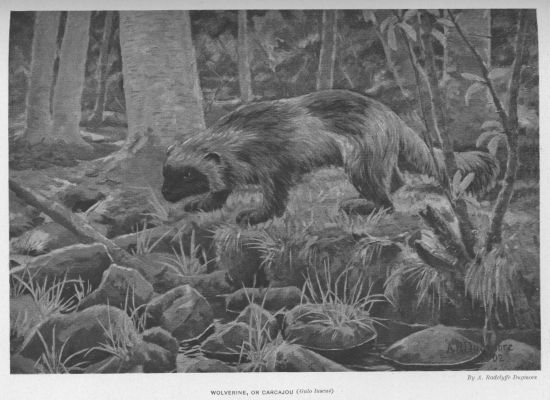
- Length
- 30 inches.
- Description
- Heavy and bear-like, walking on the sole of the foot. Hair long and shaggy; general colour blackish-brown, lighter on top and sides of the head ; feet black, a pale yellowish-white band from the middle of the body on each side, widening out on the flanks and joining over the basal portion of the tail.
- Range
- Boreal North America, Northern New York (formerly) northward.
The wolverine is a most unlovable brute, sullen and greedy; his home is in the north woods from the St. Lawrence and the Great Lakes north to the very limit of the trees and beyond. He is also occasionally found in the northern United States.
Like the skunk, he is a member of the active and sinuous weasel and marten family; and just as the skunk has developed a method of defense so effective as to allow its owner to dispense with the agility of his race and become soft and fat through laziness and lack of exercise, the wolverine has developed his native shrewdness and heavy strength at the expense of his agility.
No longer capable of running down a hare or climbing for birds and squirrels, he tramps it doggedly along through the forest, covering immense distances, and never missing an opportunity of getting a meal without risking his own safety. He now systematically robs the white and half-breed trappers of their game, the meat with which they bait their traps, and their stores of provisions, just as in past ages he undoubtedly robbed the native red man of his frozen fish and venison; and he steals from his fur-coated four-footed fellow-hunters as well.
Where winters are long and severe, lynxes, martens, weasels and foxes have been taught by hunger to practise the very closest economy. When luck goes with them and they manage to kill more than they can eat at one time, they usually bury what is left in the snow, or drag it away to some more secrete hiding place, knowing from bitter experience that all the other flesh-eaters are forever on the prowl, and not a bit overscrupulous about appropriating what they find.
But no amount of clever hiding is likely to avail them if there happens to be a wolverine in the neighbourhood. He seems to be gifted with a perfectly fiendish ingenuity in the matter of searching out buried treasures of meat, and at the same time meanly insuring himself against being robbed in return. For his capacious stomach makes it possible for him to eat more than most creatures of his size, and if anything is left after he has gorged himself he buries it and so defiles the snow about it and scents it with his disgusting odours that it is said that no other animal, no matter how hungry, will touch it.
In warm weather he probably finds it easier to satisfy his appetite in a more legitimate manner, following the summer methods of hunting adopted by most of his family, skulking through swamps and thickets after birds' nests and young creatures of various sorts that have not yet learned to take proper care of themselves.
He also feeds on insects and reptiles, and digs out the underground homes of mice and lemmings whenever his keen nose tells him that he is likely to find the little owners at home. He is even said to dig out foxes in early summer, killing and eating the fox cubs when he is so lucky as to succeed in cornering them at the extremity of their den.
The wolverine's own home is a burrow, and here in midsummer the five or six little wolverines are born; they are somewhat lighter coloured and more attractive than their parent, who shows her one admirable trait in her affection for them and her fearless attacks on any man or beast that threatens their safety.
When I think of the wolverine I always seem to see him through distant openings in low, dark northern forests, where the pointed spruce trees thin out at the edge of the barren, and the dull snow-threatening winter sky hangs close over the endless snow beneath; not even the little blue fox or musk-ox seems more suggestive of the northern cold.
The wolverine is thoroughly hated by Indian and white trapper alike; he is often known as Indian devil, or north shore devil, and his capture gives greater satisfaction than the value of his fur alone would seem to warrant.
But his catching is no such easy matter, for he is slyer than a fox when it comes to springing a trap without harm to himself. The most successful method of trapping him seems to be to bury both trap and bait deep in the snow, as if with the intention of keeping it away from him.