Home › Volumes › American Animals › Rats, Mice and Lemmings
White-footed Mouse
Also called: Deer Mouse, Wood Mouse.
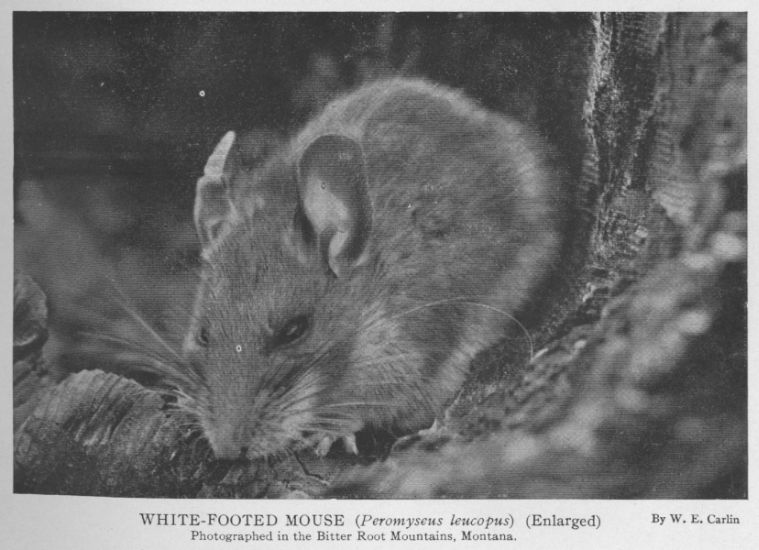
Length.—6.80 inches.
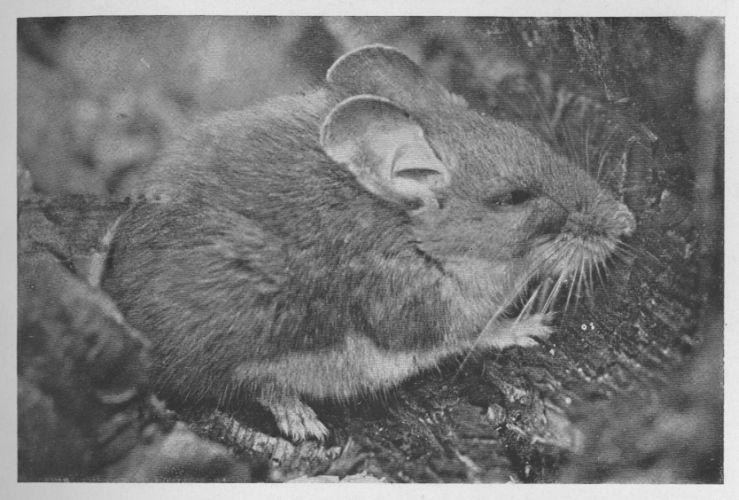
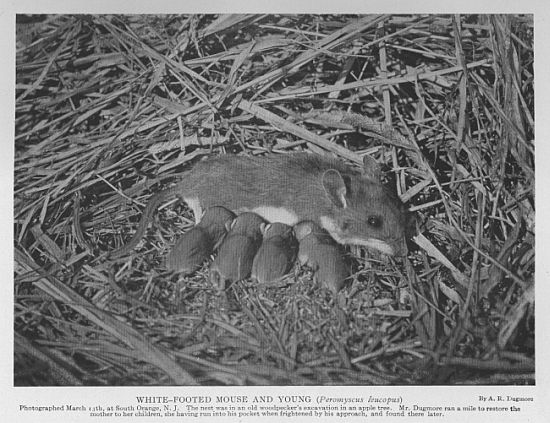
Description.—Brownish fawn colour above, brightest on the sides and darkest on the back where there is a considerable sprinkling of black hairs. Below white, fur plumbeous at its base, tail dusky above, light beneath, feet white. Young plumbeous gray over the whole upper surface with no brownish or fawn tints, white below.
Range.—Eastern United States south of the evergreen forests and north of the Gulf States. Represented farther north, south and west by numerous related species and varieties.
Range.—Cold evergreen forests of Canada and New England, southward along the mountains. In northern New York and elsewhere this and the more southerly white-footed mouse occur together, the two being easily distinguishable.
Range.—A northern form of the last replacing it in the spruce and fir forests of Quebec and Nova Scotia northward.
Range.—Replaces the above to the north of Lake Superior.
Range.—Replaces P. canadensis in the spruce forests of the southernmost Alleghanies.
Range.—Lowlands of the Atlantic slope from North Carolina to Georgia, replaced South and West by allied forms.
Range.—Mississippi Valley, northward to Tennessee. This animal overlaps the range of the common white-footed mouse in Tennessee and both occur together, just as the latter, and the Canadian species do in the North.
Range.—Southern Florida, north to Brevard and Citrus County.
Range.—Bayou region of Louisiana.
The white-footed mouse is the most beautiful of all our mice, particularly in the winter, when its fur is thick and long and bright golden-fawn-colour and white in almost equal parts; the white fur, which is literally whiter than ermine, covers the entire under surface and reaches well up on the flanks and shoulders, the line of separation being clear-cut and as straight as is possible from the tip of the nose to the tip of the tail.
The white-footed mouse has eyes like those of a flying squirrel, very large and prominent and perfectly black, in brilliant contrast to the surrounding fur.
Although the name wood mouse is not much used for this animal, it has always seemed to me more suitable than any other, for it makes its home in the woods at all times and seasons; only a comparatively small proportion of them, in this part of New England, live in the fields, tempted by the ripe corn and other provender which the woods fail to supply. Wood mouse is the name I first heard it called by, and is apparently the only one ever given it in this immediate region. Deer mouse is another name frequently given to our species, either because of its speed or the color of its fur.
The white-footed mouse does not seem to be at all particular what kind of woods it inhabits; evergreens and hardwoods, and thickets of blueberry bushes are alike suited to its taste; sometimes, indeed, a lonely old tree, standing by itself on a hillside, will harbour a family They make their homes in the hollow roots and branches or knot holes, sometimes at a considerable height above the ground.
In summer they appropriate the nests of song birds, in bushes and low trees, fitting them up for use, just a as squirrels do those of hawks and crows. It appears probable, moreover, that they are not over scrupulous in the matter of waiting for the rightful owners to depart before taking possession, as they are great lovers of fresh meat and have often been caught in the act of devouring both eggs and young birds.
They are said sometimes to fashion nests of their own among the branches, beginning with a platform of loose twigs laid crosswise for a foundation. Their lives, in fact, are pretty closely copied after those of the squirrels. Their diet is almost identical; nuts, berries, and grain being what they chiefly depend on.
Like squirrels, they often find a way into granaries and farmhouses in search of food, particularly in the winter, when times are hard. for though they lay up generous stores of nuts and seeds and hibernate to a certain extent, large numbers of them are up and doing at all times in spite of the weather, gathering seeds here and there, and gleaning whatever scraps of meat may be left by the larger flesh eaters of the woods, and gnawing hungrily at any pieces of bone they may run across.
The great bleached and half prostrate stalks of the garget still retain scattered berries, shrivelled and frozen to be sure, but packed with seeds which the wood mice evidently find palatable, as they make a point of gathering them every winter.
They also climb for rose-hips and red alder berries and a little coffee-like berry that grows abundantly everywhere in the swamps. I believe that those living in the evergreen woods are in the way of searching for hemlock and spruce seeds scattered by the pine finches and cross-bills and other northern birds in their feeding.