Home › Volumes › American Animals › The Opossums
Virginia Opossum
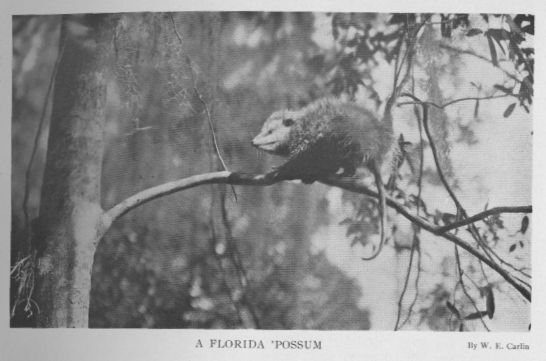
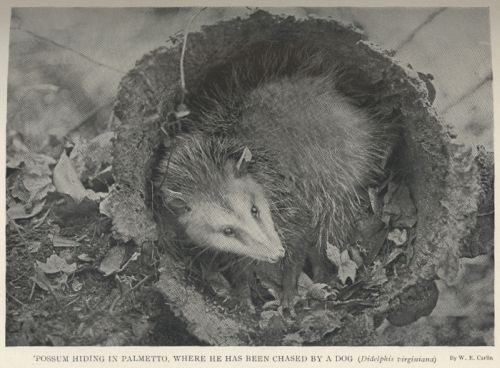
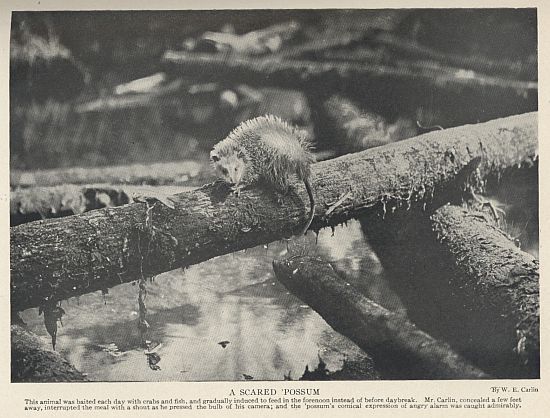
Length.—27 inches.
Description.—Hair long and rather coarse; general colour grayish white, caused by a mingling of black-tipped white under fur with long white overlying hairs; legs brownish black, feet black, toes white; head throat and middle of lower parts white; ears naked, black with white tips; tail prehensile, nearly naked, black at the base, shading into dull flesh colour.
Range.—Southern and Middle States, except in the mountains, north to the Hudson and Connecticut valleys and to southern Illinois, not ranging north of what is known as the "Carolinian Fauna." In Florida and Texas slightly different varieties occur.
Range.—Florida and lowland of Georgia along the Gulf Coast to Texas.
Range.—Texas.
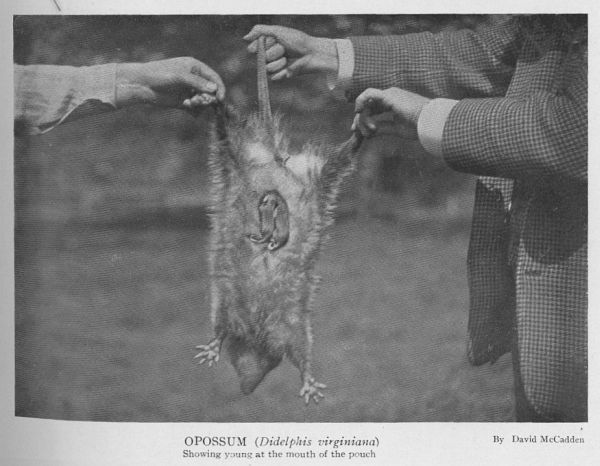
The opossum is our only representative of that remarkable class of beasts in which the young are born at such an early and undeveloped stage that the mother is obliged to carry them about in her pocket for several weeks; when first born a kangaroo, an opossum and a mouse are of very nearly the same size, about half an inch in length.
A mother opossum takes her half-dozen or more infants as fast as they are born and drops them into her pouch, where each seizes a teat and holds on; its mouth, which at first is open almost to the angle of the jaws, rapidly contracts and grows together when once it has taken hold of that which it is instinctively feeling for from the very first, and for the next few weeks the little family of brothers and sisters do nothing but sleep and grow, the old one forcing her milk into their mouths. In the meantime she is obliged to forage the woods for food and protect herself and her family as best she may.
At first thought one might very naturally infer that she would be at a decided disadvantage in being so very literally burdened with a family, yet on the whole she carries them but little longer than most other creatures of her size, the chief difference being that she has them where she can do pretty much as she pleases with them, and in case of injury is much less liable to incur serious results.
Through the day she sleeps hidden in a hollow tree or stump, or dozes half in sunshine and half in shade among the branches.
But as daylight fades and the shadows creep through the undergrowth she goes forth to see what the night has to offer her, shuffling along among the dew wet leaves, pouncing on a lizard here or a blundering dorbug that has chanced to upset itself in midflight, or else she follows up the shrill throbbing of a cricket and digs him out from his hiding place. If luck happens to be with her she may discover a nest full of eggs or young birds or mice, it is all one to her.
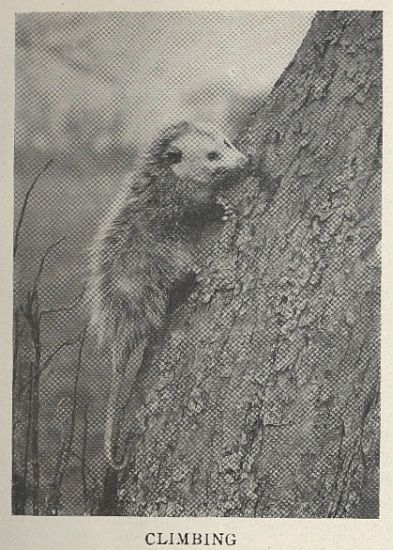
She can also climb to the top of the tallest tree in the woods using her tail and hand-shaped feet almost like a monkey, even hanging head down by her tail and one hind foot if necessary from a branch just over a bird's nest in order to reach whatever it contains. Her prehensile tail moreover often proves useful in supporting her while she gathers grapes and persimmons and other wild fruits of the forest, and it is said that the young ones when they first come out to see what the world is like, have a way of taking a couple of turns of their own tails about that of their parent and so anchored ride safely on her back. It would seem that these youngsters are not in the habit of occupying the pouch as long as do the young kangaroos, which it is said, remain there for a space of something like eight months, growing in that time from diminutive beings less than an inch long to fairly well-formed kangaroos of ten pounds weight which thrust out their necks when their parent is grazing and crop the grass beneath them. Even after they have learned to go alone they often climb back into the pouch again to ride whenever they are tired out.
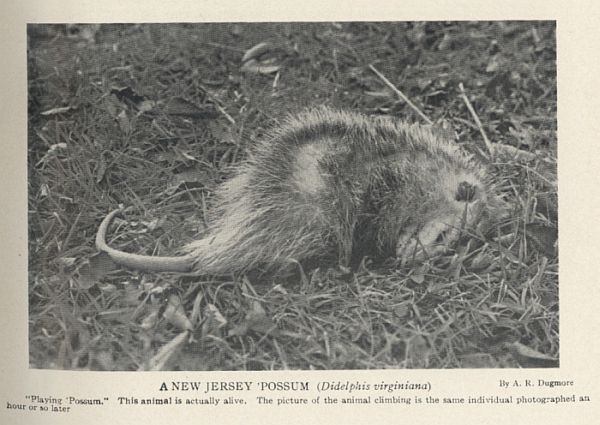
Opossums are anything but attractive or intelligent beasts. About the most marked exhibition of intelligence that they ever appear to display is their well-known trick of feigning death or playing possum as a last resort in danger. Even this has become so habitual with the species as to be almost or quite instinctive and it is doubtful if they ever knowingly pretend to be dead any more than the numerous beetles and spiders which possess the same habit.
Nature most effectually assists the possum in making the ruse successful, as anyone who has ever seen it tried is bound to admit, for the long lean dull white jaws and black withered ears and skinny tail bear in themselves the very semblance of death. And when the possum plays possum he invariably draws back the gums from his glittering white teeth until he looks as if he might have been dead for a month; especially as his fur has at all times the faded, colourless look and loose wind-blown texture of hair that has been exposed to wind and weather for an entire season.