Home › Volumes › American Animals › Rabbits and Hares
Varying Hare
Also called: Snow-shoe Rabbit, White Hare.
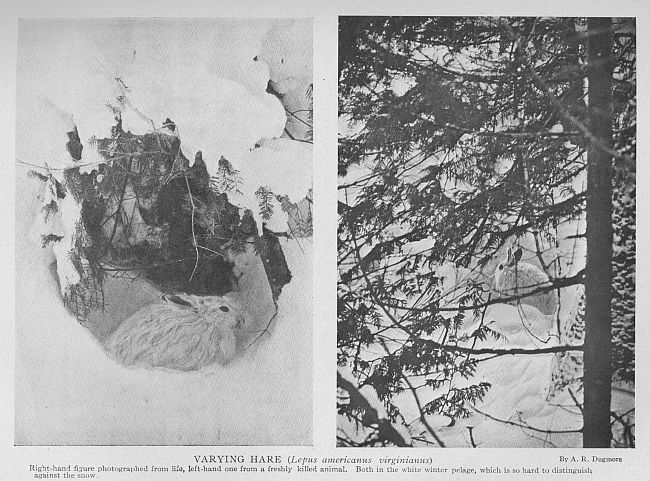
Length.—19 inches
Description.—Summer. Upper parts russet to dull ferruginous, lower parts white. Winter. Entirely white, though in southern part of its range some individuals remain partially brown throughout the winter.
Range.—Wooded regions of north-eastern North America southward along the Alleghanies to West Virginia, becoming scarce south of Maine.
Range.—Replaces the former in the wooded regions of Labrador.
Range.—Takes the place of the common form in Nova Scotia.
Our northern hare or white rabbit is a perfectly typical hare with the absurdly long hind legs characteristic of the tribe, dwelling by preference in old growth evergreen forests on gently sloping hillsides with here and there dense thickets of young spruce and pine springing up between the trunks of the older trees.
Of all our wild animals they are beyond question the most helpless and incapable. It is evidently impossible for them to use their paws for grasping as most of the smaller quadrupeds habitually do, and I have never seen any evidence of their carrying things with their mouths.
Winter and summer and in all kinds of weather they have no better shelter than the drooping boughs of an evergreen, beneath which each crouches alone for protection against the storm and concealment from its enemies, never more than half asleep apparently and always on the alert to dash away the instant it catches the scent of fox or ermine to the windward, or the crackle of a footstep in the distance. Whenever they feel hungry they venture forth and hop away to the nearest regular path or roadway used in common by all the hares in the vicinity. These paths are usually pretty straight and follow the same course the year round, often extending in an interrupted sort of way for a quarter of a mile or more with numerous side paths or cross roads of less extent, leading off in the direction of their feeding grounds. After following them for a little distance the hares usually strike off at random into the undergrowth, nibbling and browsing here and there and nosing about for vagrant leaves of grass and clover such as spring up at intervals even in the darkest forests.
Throughout the warmer months they have a large and varied assortment of herbs to choose from, and it seems not wholly improbable that they should also feed occasionally on berries and mushrooms.
The young hares from the very first are provided with no more adequate shelter than that furnished by the leaves above them, and evidently must be left quite unprotected as often as their mother is obliged to find food for herself, as the old males are said not only to exhibit no feeling of responsibility in the matter of bringing up their offsprings, but even to kill them wantonly whenever the opportunity offers.
As soon as they are able to take care of themselves, or even before, judging from outward appearances, the young ones are turned adrift to support themselves as best they may. The matter of finding food at that season is easy enough, but to avoid the numerous enemies that beset them must be much more difficult and I doubt if one out of a dozen ever attains its growth.
As winter approaches and the frosts cut off their supply of food, they find themselves compelled to depend more and more upon the bark of young trees and bushes, birch and soft maple and wild apple trees.
When the buds of the gray birch begin to swell, as they do late in the winter, the hares seem to prefer them to all other food and often wander considerable distances in search of trees with low growing branches, or clusters of young trees of last season's growth whose tops are still within their reach; and a hare standing erect on its hind feet, as is their habit at such times, is able to reach much higher than might at first be supposed.
The tall stalks of the blackberry and young trees a half inch or less in diameter they cut off close to the ground or the surface of the snow in order to get at the twigs and buds that grow beyond their reach. But it never seems to occur to them to carry any of it away to the cover of the evergreens where they sleep, and in consequence they are obliged to be abroad in all kinds of weather or go hungry until the storm is over.
They usually pass the day crouching motionless, half asleep in the shadow, though not averse to sunning themselves at midday, especially during the latter part of the winter.