Home › Volumes › American Animals › Squirrels and Marmots
Striped Spermophile
Also called: Striped Gopher.
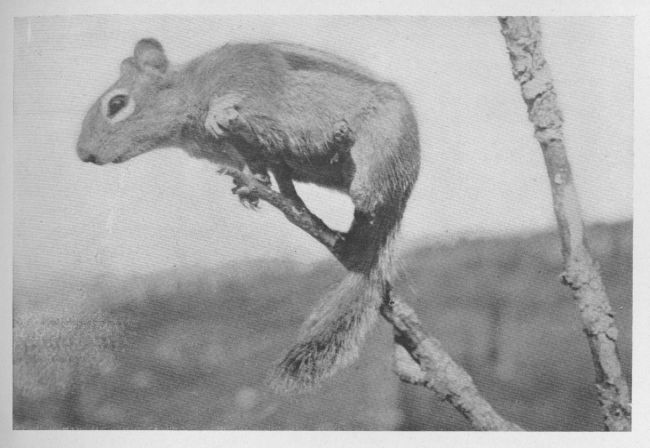
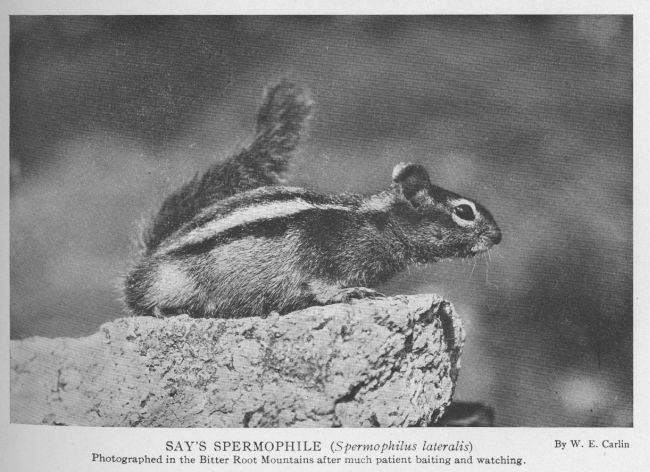
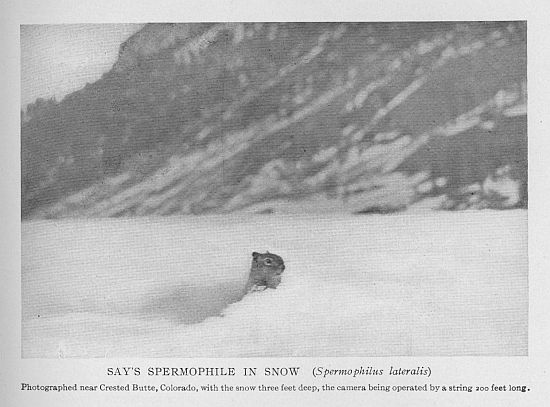
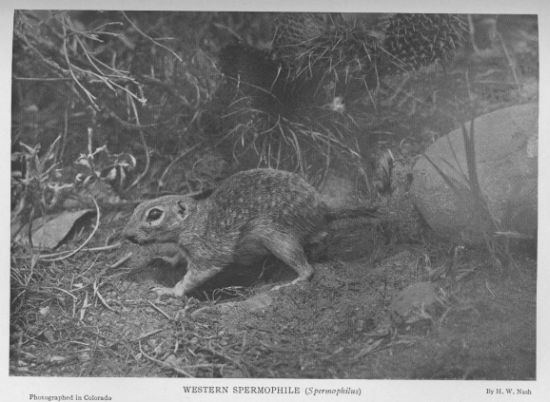
- Length
- 10 inches.
- Description
- Back striped with six buff bands and seven wider brown bands, each of the latter containing a row of small white spots; middle bands running from the top of the head to the tail, others shorter; lower parts dull buff; tail rather short, flat and rather bushy.
- Range
- Plains of the Saskatchewan; south to Texas and east to southern Wisconsin and Michigan, nearly the whole of Illinois, northern Indiana and northwestern Ohio.
The spermophiles, closely allied to the chipmunks, form as it were the connecting link between the squirrels and the marmots. They are restricted to the prairie regions of the West, where there are a number of species, two of which cross the Mississippi. The best known and most widely distributed form is the striped spermophile or "striped gopher" as it is also called. Vernon Bailey in his report upon these animals says: "Throughout the prairies of the Mississippi Valley the little striped spermophile is a familiar object as it darts through the grass to its hole or is seen standing upright on its hind feet, straight and motionless as a stick. With its short ears, smoothly rounded head, and the forefeet drooping at its sides, there is no point about its outline to catch the eye, and at a little distance it is impossible to distinguish it from old picket pin or fence stake. Standing thus the animal will often allow one to approach within a few yards, then quickly dropping on all fours it utters a shrill chatter and dives into a hole close by. Remain quiet for a few minutes and its head reappears at the entrance of the hole and the little black eyes peer at you curiously. Walk away from the place and it will soon come out and, standing up again, watch you as long as you are in within sight, uttering an occasional note of alarm or warning to its friends."
The burrows vary in length, some being short and apparently only used for shelter, while others are long with the nest at the end where the young are born, or where the animals hibernate; other adjoining cavities are used for storehouses and a large supply of grain is generally put away before winter sets in.