Home › Volumes › American Animals › Moles
Star-nosed Mole
- Length
- 6.80 inches.
- Description
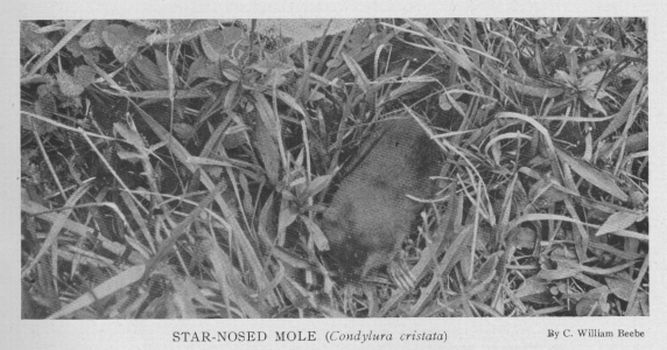
- Dark brownish gray, paler beneath, tail long and hairy--sometimes very thick at the base. Snout with a remarkable naked appendage, somewhat resembling a star.
- Range
- Northern North America, south through the middle states and farther in the mountains.
The star-nosed mole is a creature almost as well-fitted for a partially aquatic life as the otter and mink, and, as a matter of fact, does pass most of its time about the water; pushing extensive tunnels through the black peaty soil of swamps and along the borders of little brooks and ponds. The soft, black loam is thrown up in frequent heaps a foot, more or less, in diameter; the opening of the burrow being under the bank, and as often beneath the water as above. The tunnel itself must frequently be flooded to the great discomfort of its inmates.
I have never found their nests or young, and can not help wondering how they manage in times of freshet, when the meadows and swamps where they dwell are submerged.
But the old ones show no fear of the water; I have frequently seen them swimming both under water and on the surface, even where the current was pretty strong, and have always observed them to be perfectly confident and unfrightened at such times.
Drought seems to affect them much more severely than freshet, and in hot weather, after a few weeks without rain, many of them are to be found dead, evidently having perished from thirst. The star-nosed mole feeds principally upon worms and whatever else of insect life it comes across in its underground rambles, and judging by the carnivorous tastes of its relatives, I have little doubt that it varies this diet with small fish and reptiles and their eggs as well as the flesh of warm-blooded creatures whenever it is to be obtained.
If they really hibernate in winter it must be only in an interrupted sort of way, for it is not very uncommon for them to be out along unfrozen brooks in the coldest weather, and certainly either this or the common mole is often moving about just beneath deep snow, the peculiar position of the fore paws of the creature leaving a track not easily to be confounded with that of any other animal.
The most feasible theory would seem to be that they pass the winter deep down in the swamps, below the reach of the frosts, where they may carry on their subterranean work at their leisure, occasionally entering brooks to swim about beneath the ice in pursuit of water-beetles and the like.
One, which I caught in the early part of last February, 1901, must have been swimming near the middle of the brook not far from the bottom, where the water was six or eight inches deep; and although it had been in the trap under water for several days where I found it, its fur still kept out the water and dried as readily as otter fur, exhibiting the true quality of the coat of a swimming animal.
What is the life of these little earth folk like? They see and know little of the things most familiar to us and the other creatures that love the sun-warmed air and the sky.
Most so-called nocturnal creatures are fond of the sun and bask in it at mid-day, even those that are most active at night like their sun-bath at noon.
But these little "ground-dwellers" actually appear to dislike the touch of the sun from the manner in which they avoid it. They can know little more of the grass and flowers than the moist touch of the colourless root fibres that fringe the ceilings of their tunnels and the first tender shoots of the water-plants they encounter beneath the ice months before winter shows signs of breaking above ground.
Rare water-beetles and the larvae of insects, which famous entomologists would gladly give years of patient study to learn more about, must be every-day common-place matters to the mole, but whether his "dim-eyed understanding" holds any definite image of the things he so diligently searches for or not is never to be known. Does he really distinguish between the various kinds, I wonder, more than their taste and the crunch of their crisp wing covers between his teeth? I feel certain, that while he is digging away earnestly down in the dark for his dinner, such dull thought as he has is centred on the prospects of a lucky catch, and naturally certain species of fat and well-flavoured grubs would appeal more strongly to his appetite than others.
By the law of just compensation, his immense appetite and the matter of eating, which occupies so very much of his time, ought rightly to yield him a great deal of pleasure, there seems so little else for him to enjoy.