Home › Volumes › American Animals › Weasels, Otters, Etc.
Skunk
Also called: Polecat.
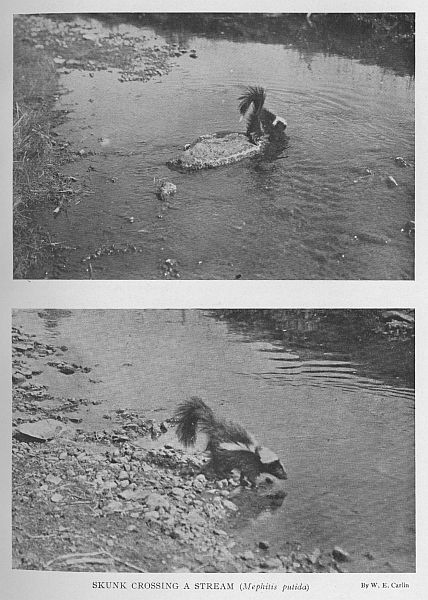
Length.—2 feet.
Description.—Body covered with long hair, tail very large and bushy; colour black with a white patch on the back of the neck, from which two stripes extend down the back and along the sides of the tail, and a white stripe down the forehead. Sometimes the white is almost restricted to the patch on the neck, and in the other specimens the stripes are united, making the whole back white.
Range.—New England to Virginia and Indiana, replaced to the North and South by closely allied varieties.
Range.—Nova Scotia, Quebec and Ontario.
Range.—Florida to North Carolina and Southern Mississippi.
Range.—Louisiana to Texas and Missouri.
Range.—Prairie region of Illinois, Indiana and Eastern Iowa.
The skunk belongs in the same group with the minks and weasels, all the members of which are capable of emitting a powerful, almost suffocating odour when angry, and this undoubtedly gives them a decided advantage in a hand-to-hand combat. But the present species has made itself notorious by perfecting this gift to a degree that furnishes it with a complete defense against all but the most desperate enemies. The general effect on the race is very noticeable.
No longer being compelled to be forever on the alert to escape or repulse the sudden attacks of an enemy, the little beast of the black and white fur has grown fat and lazy. It still retains much of the slender and graceful form of the weasels, but has allowed its muscles to become soft and tender, and so burdened with fat as to render rapid and prolonged exertion almost an impossibility; its flesh in the meantime having become palatable to every meat-eating creature, not even excepting man. All those who through want or curiosity have ever tasted it, agree in pronouncing it equal in flavour and tenderness to that of any four-footed creature; while no one, not even an Indian or a wolf, will eat the flesh of a mink or weasel unless rendered desperate by hunger. Is it not possible that the peculiar quality of the flesh of these weasels has been developed partly as a safeguard?
For large, warm-blooded game of whose flesh it still retains the fondness characteristic of its family, the skunk must depend on luck or strategy to supply the want of the agility which its race has thrown away. During the summer and autumn this loss is hardly felt; grasshoppers, crickets and the like are to be picked up everywhere in abundance, and compose the regular fare of the species; snakes are also caught by them in considerable numbers, and birds' nests containing eggs or helpless young are to be had for the seeking. The short burrows of the field-mice seldom reach many inches below the turf, and the nests containing the young mice are easily uncovered.
Catching grasshoppers in the hot sunshine of mid-summer is not by any means an easy task, but by moonlight or the early gray of the morning while the grass is heavy with dew it is more like picking strawberries than hunting.
As the season wears on the nights grow longer and the dew heavier, while the grasshoppers and crickets get bigger and more sluggish. By the last of October the skunks go rolling and tottering about on feet that are apparently much too small and much too close together to support them comfortably, the creature's anatomical structure being still like that of the other weasels and scarcely fitted for carrying such a load of fat with ease and dignity.
By the time the supply of insect food comes to an end the skunk finds himself quite unfitted to engage in more active hunting, so he proceeds to look up a suitable underground retreat in which to pass the winter. If his summer home has been in the woods, then the same burrow which he has been occupying is all that is required; and if, as is usually the case, he is still living with his family, numbering perhaps six or eight members, they all turn in together and sleep for weeks or even months.
Those that have passed the warm season in the open, where the ground freezes too deeply to be comfortable in winter, are under the necessity of looking up lodgings in the woods before the snow comes.
It often happens that such a family will hit upon a hole already occupied, and the two families, aggregating a dozen or more individuals, will pass the cold season together in perfect harmony.
The original occupants, if they are sufficiently awake to realize anything, are probably glad of the additional warmth contributed by the new comers.
Skunks are easily the most abundant of all our carnivora, yet I have never seen more than five or six, all told, out of their own accord in the daytime. In the evening, particularly in warm weather, it is common enough to see them moving about in the uncertain light with the leisurely, unhurried manner which they usually affect.